

On this page
TL;DR: IT staff augmentation’s real benefits are speed, specialist access, cost flexibility, and IP control — but each benefit has a condition attached. Speed requires a pre-vetted bench, not a new search. Cost savings of 40–60% require offshore sourcing with genuine vetting rigour, not the cheapest available rate. Access to AI/ML engineers works because augmentation reaches a global pool that local hiring cannot. None of these benefits arrive automatically. They depend on the quality of the provider and the readiness of your team.
Why Most “Benefits” Articles Get This Wrong
The standard list of staff augmentation benefits reads the same across every provider’s blog: faster hiring, lower cost, flexible scaling, access to skills. All of these are real. None of them tells you when they apply, by how much, or what conditions must exist for them to materialise.
This article pairs each benefit with the data behind it and the condition that determines whether your engagement delivers it. If you are evaluating whether staff augmentation fits your situation, the conditions matter more than the benefits themselves.
Benefit 1: Speed to First Engineer — 1–2 Weeks vs 44 Days
The data: The SHRM 2025 Recruiting Benchmarking Report found the median time-to-fill was 44 days for non-executive roles and 45 days for executive positions — before notice period or ramp-up. For specialist roles (AI/ML engineers, security architects, senior DevOps), it runs 70+ days. Staff augmentation with a provider holding a pre-vetted bench delivers a shortlist in five business days and a first pull request in one to two weeks.
The condition: The speed advantage exists only if the provider maintains an actively vetted pool — not if they are sourcing from scratch in response to your brief. Ask directly: “Are the profiles you will show me from an existing vetted bench, or will you source them after we sign?” Any provider sourcing from scratch after engagement takes 4–6 weeks, which narrows the speed gap significantly.
At InApps, matched profiles reach you within five business days. The average time to first engineer on a sprint is one week.
“When you’re already behind on a roadmap, a partner who takes 60 days to produce a shortlist isn’t solving your problem.” — Divogue Engineering Intelligence, 2026
Benefit 2: Access to Scarce Skills — Especially AI/ML
The data: Between January 2025 and January 2026, employers posted 1,229,505 jobs requiring AI skills (CompTIA, 2026). Jobs requiring specific AI skills grew by 69% year-over-year — nearly eight times faster than the overall jobs market, which grew 9% (PwC 2026 AI Jobs Barometer). ManpowerGroup’s 2026 survey of 39,000 employers found AI model and application development has overtaken traditional IT as the hardest capability to find globally.
The condition: Augmentation reaches the global pool for these roles; local hiring does not. A company in Austin or London is not competing for a Vietnam-based ML engineer through traditional recruiting. Augmentation makes that talent accessible in weeks without relocating the engineer or the team.
The same principle applies to: cloud architects, senior DevOps, security engineers, LLM specialists, and QA automation engineers — all roles where demand structurally exceeds local supply in every major US and European market.
What this looks like at InApps: Engineers covering LangChain, LangGraph, RAG pipelines, pgvector, OpenAI and Anthropic APIs are drawn from the same vetted pool as frontend and backend engineers. Stack coverage extends to LlamaIndex, Dify, n8n, and Flowise for AI workflow automation. Niche stacks take two to four weeks to place; common stacks take one.
Benefit 3: Cost Reduction — 40–60%, Under Specific Conditions
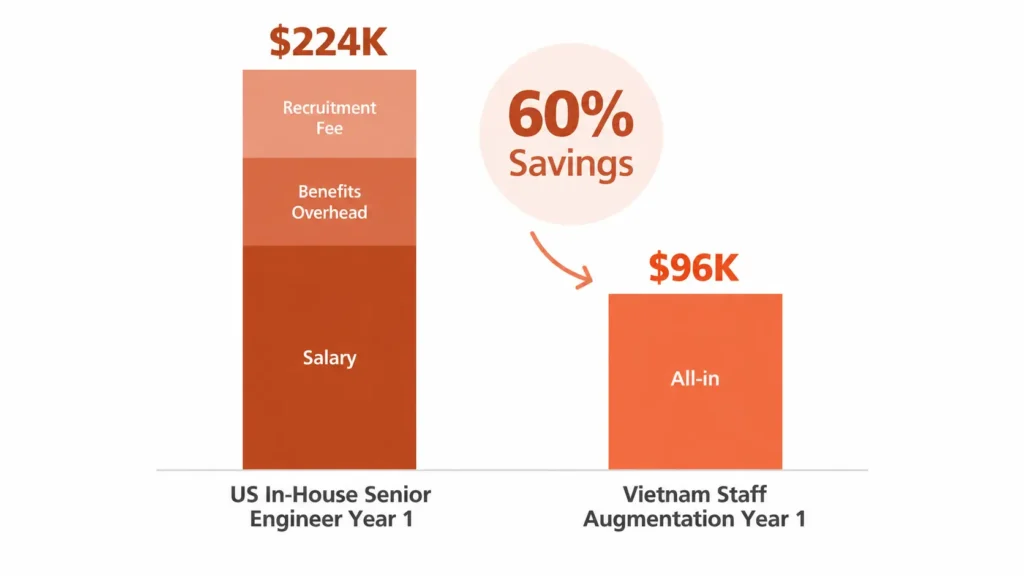
The data: IT staff augmentation can reduce hiring costs by 40–60% compared to equivalent in-house hiring (Nerdify Research, cited by DataToBiz 2026). BLS data from March 2026 puts total employer compensation for management and professional occupations at $78.10/hour — including $24.61 in benefits, representing 31.5% overhead on top of wages.
For a US senior software engineer earning $140,000 base salary:
- Employer overhead (benefits, payroll tax, equipment): +$42,000–$56,000
- Recruitment cost (agency fee): $14,000–$28,000 one-time
- Year-one total: $196,000–$224,000
A Vietnam-based senior engineer via InApps at the 2026 market rate of $30–$50/hour runs $57,600–$96,000/year all-in — including employment, payroll, workspace, equipment, and ISO 27001:2022 controls. No recruitment fee, no employer overhead, no minimum-term penalty.
The condition: The savings calculation assumes offshore sourcing with genuine vetting rigour. A “cheap” offshore quote with poor vetting delivers 30–35% month-one productivity loss from onboarding friction. Radixweb’s 2026 analysis found that on poorly prepared legacy codebases, real total engagement cost runs 20–40% above the quoted rate from ramp-up delays and management overhead alone. The cost advantage is real; the headline rate is not the total cost.
What this does not apply to: Cost reduction is not the primary driver for most 2026 augmentation decisions. Deloitte’s Global Outsourcing Survey found the share of companies citing cost reduction as their top driver fell from 70% in 2020 to 34% in 2024 — with talent access and delivery agility now leading.
Benefit 4: Flexibility to Scale Without Headcount Risk
The data: 55% of survey respondents in 2026 believe their IT structures are effective for now but would need restructuring soon (DataToBiz 2026). Engineering demand is not constant — products have high-pressure delivery phases (launches, migrations, compliance deadlines) and lower-intensity periods. Maintaining a permanent team sized for peak demand creates expensive underutilisation during troughs.
Augmentation converts that fixed overhead to variable spend: capacity goes up when the roadmap demands it and comes down when it does not, without redundancy costs, severance, or the morale impact of headcount reductions.
Employee turnover costs an estimated 33% of base wages (Work Institute, 2025 Retention Report) — replacing an engineer earning $100,000 costs at least $33,000. Augmentation eliminates that risk for time-bound roles.
The condition: Flexibility is real at the individual engineer level. Scaling a dedicated team of six engineers down to two still takes 30 days’ notice and creates disruption. For maximum flexibility, augmentation works best when team size is five engineers or fewer. Above that threshold, a dedicated team model’s continuity often outweighs augmentation’s flexibility advantage.
At InApps: two weeks’ notice to add or remove engineers. No minimum-term lock-in beyond the initial agreed period.
Benefit 5: Full IP Ownership From Day One
The data: This benefit is contract-dependent, but it distinguishes augmentation from project outsourcing in a way that matters significantly for product companies. In project outsourcing, the vendor manages the delivery process — IP transfer terms vary, and transfer is sometimes gated behind final payment. In augmentation, engineers commit directly to your repository from the first line of code.
The condition: IP ownership must be explicit in the engagement agreement — not assumed. Verify three things before signing: (1) IP transfers on creation, not on final payment; (2) code lives in your repository throughout the engagement, not on the provider’s infrastructure; (3) no component is retained or reused across other client accounts.
Under Vietnamese law (Article 39, Law on Intellectual Property), economic rights in work created on assignment belong to InApps as the employer, and are assigned to you under the engagement agreement from the first commit. The chain is explicit and auditable.
Benefit 6: Reduced Recruitment and Legal Risk
The data: 89% of organisations report that candidate ghosting is a recurring recruitment problem, increasing overheads and delays (Economic Times HR 2025). The average cost per hire was $1,200 for non-executive roles in 2025 (SHRM); recruiting fees for senior technical roles via agencies typically run 15–25% of annual salary — $21,000–$37,500 for a $150,000 base. Staff augmentation eliminates both the ghosting risk and the agency fee entirely.
For offshore engagement, the provider also carries Vietnamese labour compliance, payroll, and employment risk — you do not incorporate a local entity, manage payroll tax in a foreign jurisdiction, or navigate local employment law. At InApps, all employment, payroll, equipment, and compliance sit with InApps. You carry none of it.
The condition: This benefit is fully delivered only when the provider is a genuine employer of record — not when they subcontract to freelancers through a marketplace. Ask directly: “Are the engineers employed by you, or are they independent contractors?” An employer of record provides NDA coverage, consistent security controls, and IP assignment backed by an employment relationship. A freelancer marketplace does not.
Benefit 7: Knowledge Transfer Without Permanent Overhead
The data: Deloitte’s 2024 Global Human Capital Trends report found that organisations prioritising workforce learning and capability building are 1.5x more likely to anticipate change effectively. Augmentation engagements, when structured deliberately, build internal capability: augmented engineers pair with internal leads, contribute to documentation, and participate in architecture decisions that stay with your team after the engagement ends.
The condition: Knowledge transfer does not happen by default. Augmented engineers who disengage at the end of an engagement take their codebase knowledge with them unless documentation is built in from day one — not in a sprint at the end. Structure this in: require documentation of significant implementations as a definition-of-done criterion from sprint one. Pair augmented engineers with internal leads explicitly.
When Staff Augmentation Does NOT Deliver These Benefits
The conditions attached to each benefit above point to a pattern: staff augmentation fails when the wrong conditions exist at the client or provider level.
| Condition missing | Benefit that fails | What happens instead |
|---|---|---|
| No internal tech lead to direct work | Speed and cost | Engineers wait for direction; management overhead erodes savings |
| Provider sources from scratch (no bench) | Speed | 4–6 week placement that matches traditional hiring |
| Poorly vetted engineers | Cost | 20–40% ramp-up cost above quoted rate; rework |
| Short engagement (<6 weeks) | Cost efficiency | Ramp-up cost > output delivered |
| Engagement under 6 weeks | Flexibility | Ramp-up investment not amortised |
| No IP clause in contract | IP ownership | Ambiguous ownership at contract end |
| Provider uses freelancers, not employees | Risk reduction | No employment-backed NDA or compliance coverage |
| No documentation discipline | Knowledge transfer | Context leaves when the engineer does |
The Honest Summary: 7 Benefits, 7 Conditions
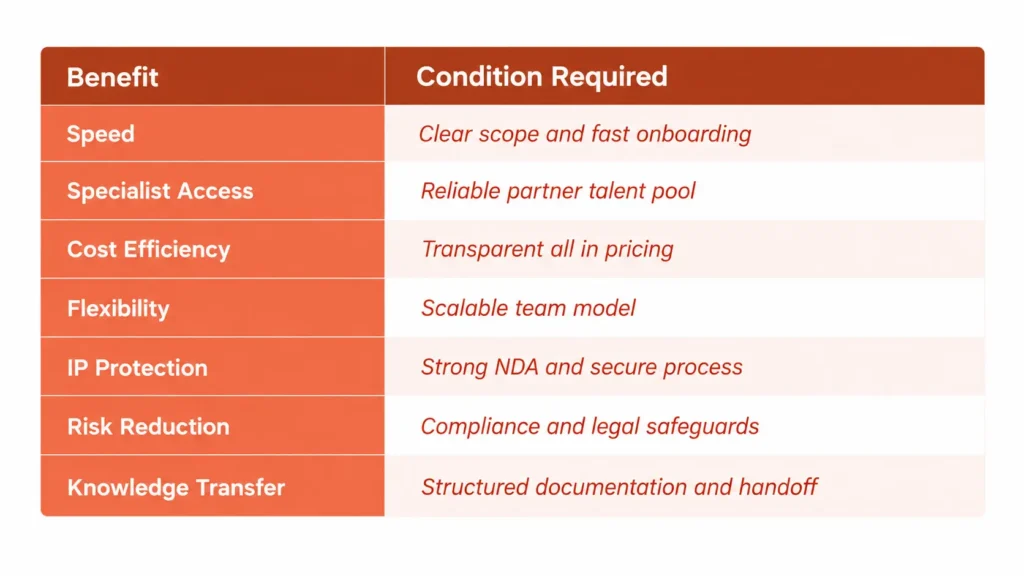
| Benefit | Condition for it to deliver |
|---|---|
| ⚡ Speed (1–2 weeks vs 44 days) | Provider has an active pre-vetted bench |
| 🎯 Specialist access (AI/ML, DevOps, security) | Global pool via offshore; local hiring cannot reach it |
| 💰 Cost reduction (40–60%) | Offshore sourcing + genuine vetting rigour |
| 🔄 Flexibility (2 weeks’ notice) | Team size ≤5 engineers; above that, dedicated team is better |
| ©️ IP ownership (from first commit) | Explicit assignment clause in the engagement agreement |
| ⚖️ Reduced legal/recruitment risk | Provider is an employer of record, not a freelancer marketplace |
| 📚 Knowledge transfer | Documentation built in as definition-of-done from sprint 1 |
How InApps Delivers Each Benefit
InApps is structured to deliver all seven benefits under the conditions that make them real — not as a list of promises, but as operational commitments with verifiable numbers.
| Benefit | How InApps delivers it |
|---|---|
| Speed | Matched profiles in 5 business days. Average 1 week to first engineer. |
| Specialist access | Pool covers LangChain, LangGraph, RAG, LlamaIndex, pgvector, Dify, n8n — plus all common stacks |
| Cost reduction | Vietnam senior engineers at $30–50/hr (2026 market range) — 60–70% below US/EU rates |
| Flexibility | 2 weeks’ notice, both directions. No minimum-term lock-in. |
| IP ownership | Assigned from first commit in the engagement agreement |
| Risk reduction | InApps is employer of record — employment, payroll, NDA, ISO 27001:2022, company-managed devices |
| Knowledge transfer | Performance check-ins every 4 weeks; account manager monitors documentation discipline |
200+ engineers placed. 94% client re-engagement. 92% of engineers on the same account after 12 months. 4.9/5 on Clutch from 50+ verified reviews.
“Quality engineers, proposed within days. But what actually made the difference was the culture fit — they worked like they were part of our team from day one.” — Engineering Leader, Future Processing (InApps client)
Ready to put the benefits to work? Talk to a Solutions Consultant → — no pitch, no discovery invoice, matched profiles within five days.
Frequently Asked Questions
What are the main benefits of IT staff augmentation?
Seven measurable benefits: speed to first engineer (1–2 weeks vs 44-day median hire time), access to scarce specialists (AI/ML, DevOps, security) through a global pool local hiring cannot reach, cost reduction of 40–60% for offshore sourcing with proper vetting, flexibility to scale in two weeks’ notice, full IP ownership from the first commit, reduced recruitment and employment risk, and knowledge transfer when documentation is built in as a delivery criterion.
How much can companies save with IT staff augmentation?
40–60% compared to equivalent in-house hiring costs, based on 2026 data from Nerdify Research. For a US senior engineer costing $196,000–$224,000 in year-one total (salary + overhead + recruitment), a Vietnam-based senior engineer via InApps at the 2026 market rate runs $57,600–$96,000 all-in. The savings require offshore sourcing and genuine vetting rigour — a cheap rate without quality vetting adds 20–40% to the real total cost through ramp-up delays.
How quickly can you get an engineer through staff augmentation?
1–2 weeks with a provider that maintains a pre-vetted bench. The speed advantage collapses to 4–6 weeks if the provider sources from scratch after you brief them. Ask any provider: “Are the profiles from your existing vetted pool, or will you source them fresh?” The answer tells you whether the speed benefit is real for your engagement.
What are the risks of IT staff augmentation?
Four main risks: (1) No internal tech lead to direct the work — augmented engineers without direction create management overhead that erodes the cost advantage; (2) poor provider vetting — low-quality engineers increase ramp-up loss and rework by 20–40% of quoted rate; (3) knowledge loss when the engagement ends — context leaves with the engineer unless documentation is built in from the start; (4) IP ambiguity — if the contract does not assign IP on creation, ownership is unclear at engagement end.
Is IT staff augmentation better than hiring in-house?
For time-bound needs (3–18 months), specific skill gaps, and roles where the global talent pool is the only viable source (AI/ML, security architecture), augmentation delivers lower cost, faster access, and more flexibility than in-house hiring. For long-term, ongoing product development with deep institutional knowledge requirements, a dedicated team or in-house hire often produces better long-term economics. The decision turns on duration, specificity of the need, and whether internal management capacity exists to direct the work.
Does staff augmentation give you IP ownership?
Yes — if the engagement agreement explicitly assigns IP on creation. Code should live in your repository from the first commit, not on the provider’s infrastructure, and IP transfer should not be gated behind final payment. Verify three things in the contract: IP transfers on creation, code lives in your repo throughout, and no components are retained or reused on other accounts. At InApps, IP is assigned to you under the engagement agreement from the first commit.
Key Takeaways
- Speed benefit (1–2 weeks) requires a pre-vetted bench — not a fresh search after signing.
- Cost savings of 40–60% are real for offshore augmentation with quality vetting; a cheap rate without rigour adds 20–40% in hidden costs.
- 1.23 million AI-skill job postings (Jan 2025–Jan 2026) signal why augmentation is the primary path to AI/ML talent that local hiring cannot reach.
- Flexibility (2 weeks’ notice) works best for ≤5 engineers; above that, a dedicated team’s continuity often wins.
- IP ownership is contract-dependent — verify the clause before signing.
- Knowledge transfer requires deliberate documentation discipline from sprint 1, not a handover sprint at the end.
- Cost reduction is no longer the top driver: Deloitte 2024 found talent access and agility now lead (cost reduction fell from 70% to 34% as top motive since 2020).
Work with us
Need a team that can do this on your codebase?
Tell us what you are shipping and we will send back a scope, a team shape and a fee. No obligation.
Book a free call