

On this page
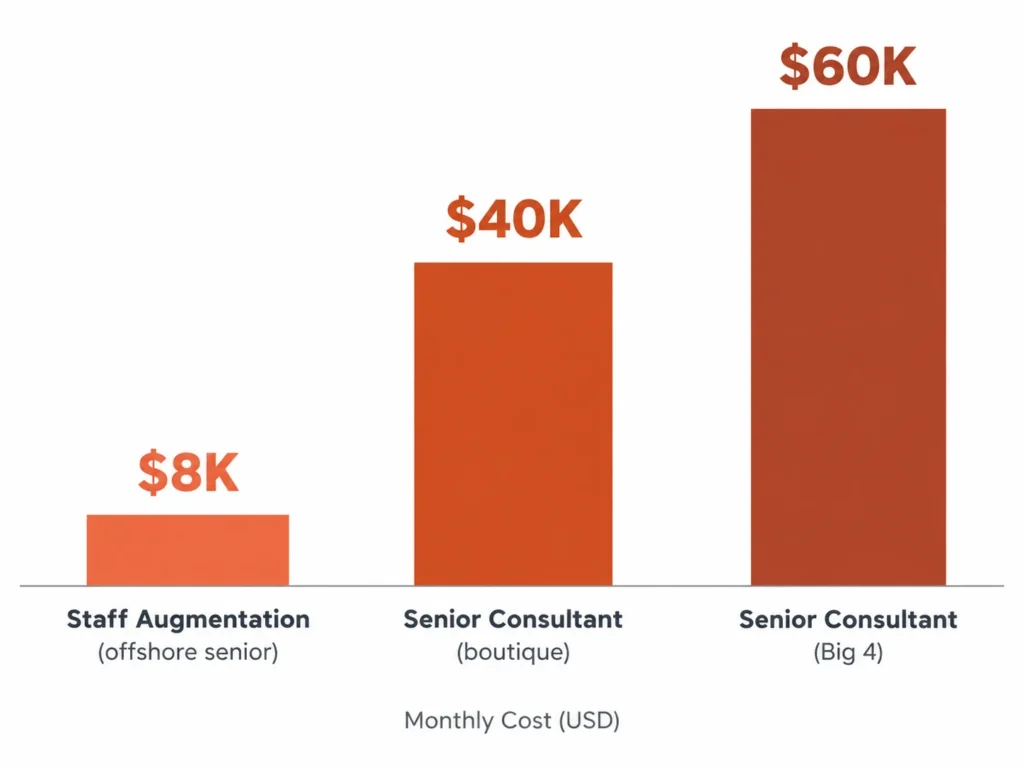
TL;DR: Staff augmentation fills a capacity gap — you know what to build and need engineers to build it. Consulting fills a capability gap — you need expertise to decide what to build or how. Senior consultants from top firms run $60,000/month per person; senior engineers via offshore staff augmentation run $8,000/month. The right model depends on whether your problem is execution or direction.
What Is the Core Difference Between Staff Augmentation and Consulting?
The most useful distinction between staff augmentation and consulting is not seniority or rate — it is the type of gap being filled. Staff augmentation addresses a capacity gap: you have a clear roadmap, technical leadership in place, and need execution power. Consulting addresses a capability gap: you need outside expertise to diagnose a problem, design a solution, or define the right architecture before anyone starts building.
Staff augmentation puts engineers under your management, in your tools, on your backlog. Consulting puts experts in charge of a defined outcome — a strategy document, a migration plan, an architecture decision record — then exits. The code stays with you in augmentation; the knowledge stays with you (if documented) in consulting.
“Capacity gap: you know what must be built but don’t have enough qualified people to build it. Capability gap: you don’t yet know the right solution, architecture, or delivery approach.” — TekRecruiter Engineering Intelligence, 2026
Staff Augmentation vs Consulting: Side-by-Side Comparison
| Criterion | Staff Augmentation | IT Consulting |
|---|---|---|
| Gap being solved | Capacity — execution bandwidth | Capability — strategy, architecture, direction |
| Who manages daily work | Your engineering lead | Consultant’s own methodology |
| Who owns outcomes | Your team | Consulting firm (against defined deliverables) |
| Primary deliverable | Code, merged PRs, shipped features | Reports, roadmaps, architecture docs, POC |
| IP ownership | 100% yours, from first commit | Depends on contract — verify explicitly |
| Cost (senior, offshore) | ~$8,000/month per engineer | ~$40,000–$60,000/month per consultant |
| Cost ratio | 1x | 5–8x |
| Engagement length | 3–24 months | 4–16 weeks per phase |
| Scope flexibility | High — re-prioritise every sprint | Low — changes trigger SOW amendments |
| Knowledge transfer | Continuous, in-team | Dependent on documentation quality |
| Time to first output | 1–2 weeks (first PRs) | 4–8 weeks (first deliverable) |
| What happens when they leave | Code stays in your repo | Recommendations stay in a deck |
| Requires internal tech lead | Yes — someone must direct the work | No — consultants self-direct |
| Best when | Roadmap is clear, need build velocity | Problem definition is unclear, need expert diagnosis |
When to Choose Staff Augmentation
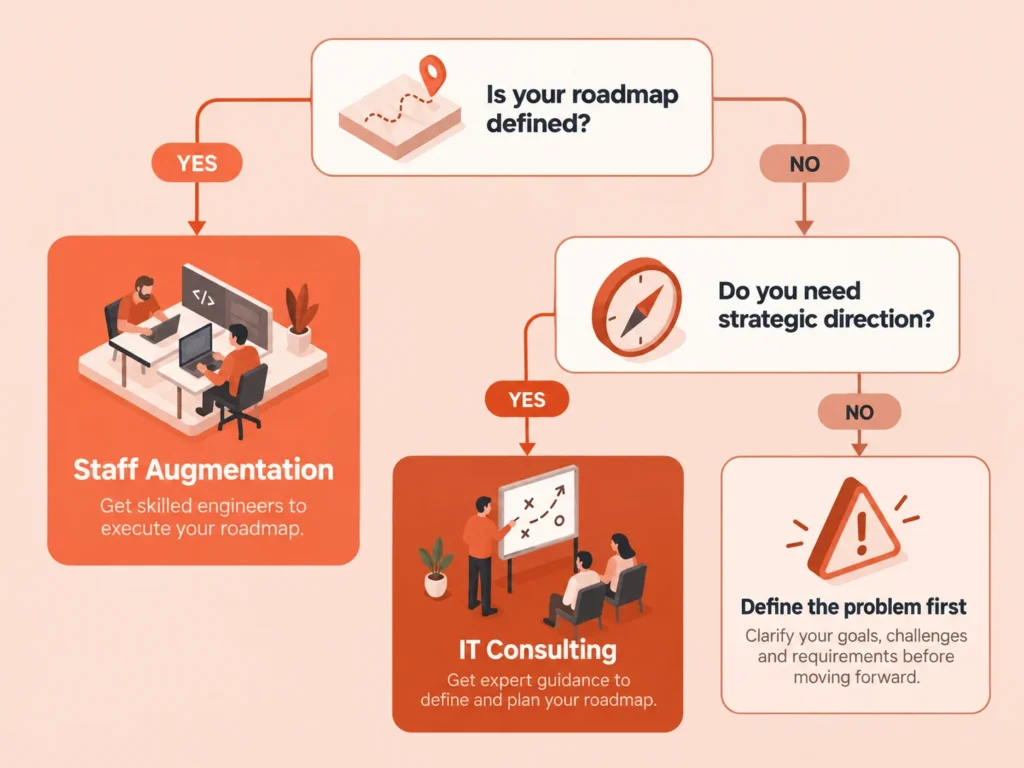
Staff augmentation is the right model when the engineering problem is defined and the constraint is throughput, not direction.
You have technical leadership who can direct the work. Every staff augmentation engagement requires someone on your side to set priorities, review pull requests, and unblock engineers. A CTO, VP Engineering, or a strong tech lead is the prerequisite. Without that, augmentation becomes a management tax on your senior people — paying contractor rates while your own leaders spend their week onboarding and unblocking instead of building.
Your roadmap is clear. When the backlog is prioritised and the architecture is decided, what you need is execution velocity. Gartner engineering productivity benchmarks put senior engineers at 5–15 merged PRs per month in a functioning team. Staff augmentation scales that throughput without the 3–4 month hiring cycle.
The work is core product IP. When the code being written is central to your product’s differentiation — proprietary algorithms, customer-facing features, data pipelines — you want that work in your repository, reviewed by your engineers, under your architecture standards. Staff augmentation keeps it there. Consulting engagements often produce work that leaves with the consultant.
You need flexibility as the scope evolves. Per IDC 2026, worldwide IT staffing spend is projected to exceed $580 billion, with staff augmentation growing faster than any other model — driven by scope variability. Adding a DevOps specialist mid-project, or scaling from three engineers to five for a release sprint and back down, happens on two weeks’ notice. Under a consulting SOW, that triggers a change order.
When to Choose IT Consulting
Consulting earns its premium when the problem is not yet defined well enough to build against.
You need an independent architecture assessment. When a system is failing in ways your team cannot diagnose, or when you are about to invest in an approach that may be wrong, an external expert who has seen the same failure mode at ten other companies is worth the rate premium. The deliverable is clarity before commitment — cheaper than six months building in the wrong direction.
A strategic decision requires external credibility. Board-level technology decisions, due diligence for acquisitions, and regulatory compliance assessments often require an independent expert opinion. A consulting firm’s report carries weight that an internal recommendation may not.
You are running a transformation with no internal expertise. Cloud migration strategy, AI adoption roadmaps, and platform architecture redesigns are areas where consulting adds genuine value — not because your engineers cannot execute, but because the strategic framing of what to execute requires expertise your team may not have encountered before.
The engagement has a defined end. Consulting works best when it produces something your team can own and act on independently: a prioritised migration plan, an architecture decision record, an AI readiness assessment. At InApps, our AI Consulting engagement runs two weeks, returns a scored use-case roadmap and a working prototype on staging, and credits the fee against the build. The assessment ends; the artefacts stay.
The limit of consulting is consistent across engagements: the consultants exit before the integration work begins. TekRecruiter’s 2026 analysis of failed consulting engagements found the most common pattern is a strong strategy document with no implementation capacity to act on it — leaving the client paying consultant rates for a plan and hiring engineers separately to execute it.
Cost Comparison: What the Rate Difference Actually Means
| Cost element | Staff Augmentation | IT Consulting |
|---|---|---|
| Senior engineer, offshore (Vietnam) | ~$8,000/month all-in | — |
| Senior engineer, onshore (US) | ~$18,000/month | — |
| Senior consultant (regional/boutique) | — | ~$40,000/month |
| Senior consultant (Big 4/top firm) | — | ~$60,000/month |
| Cost ratio | 1x baseline | 5–8x |
| For the cost of 3 consultants for one quarter | Hire 5 senior engineers for 5 months | 3 consultants for 3 months |
| Output per month | 5–15 merged PRs per engineer | 1–2 deliverables per quarter |
| What stays when they leave | Code in your repository | Document in your inbox |
| Scope change cost | Reprioritise the backlog | Change order, renegotiation |
Source: BLS data, consulting industry rate cards, Second Talent developer rate card 2026
The rate gap is not an argument against consulting — it reflects a genuine difference in what is being bought. A Big 4 consultant brings proprietary benchmarking data, industry relationships, and decades of pattern recognition that a staff engineer does not. But that premium only makes sense when the problem is strategic. When the problem is execution, paying consulting rates for engineering capacity is one of the more reliably expensive mistakes a CTO can make.
Red Flags When Evaluating Each Model
| Red Flag | What It Signals | What to Ask |
|---|---|---|
| Consulting firm promises to also “deliver the build” | Consultants will write the SOW; engineers are a different team you have not met | “Who are the named engineers, and what’s their vetting process?” |
| Staff augmentation provider cannot shortlist in under a week | Thin bench — not truly pre-vetted talent | “What is your current bench size for this stack?” |
| Consulting engagement has no working prototype in scope | You will get a deck, not evidence | “What do we have at the end of phase one that we can run?” |
| Augmentation provider cannot name a replacement process | You have no recourse if the engineer is wrong | “What is your 30-day replacement guarantee?” |
| Consulting SOW has no IP assignment clause | Deliverables and methods may not be yours | “Does IP transfer on signature or on final payment?” |
| Staff aug provider charges a bench fee between placements | You pay for capacity you do not use | “Is pricing strictly time-and-materials per placed engineer?” |
How InApps Positions Each Model
InApps runs both — and will tell you which one fits before you sign anything.
IT Staff Augmentation at InApps places named senior engineers into your sprint in 1–2 weeks. They report to your engineering lead, work in your tools, and follow your definition of done. 3% of applicants pass the four-stage vetting process. 94% of clients re-engage. Two weeks’ notice to scale in either direction. IP is assigned to you from the first commit.
AI Consulting at InApps runs a two-week fixed-fee assessment that returns four artefacts: a systems and data audit, use cases scored on value and feasibility, a costed phased roadmap, and one working prototype on staging against your own records. The fee is credited against the build if you proceed. The engagement ends with evidence, not a recommendation to trust on faith.
The difference in our own portfolio: augmentation clients typically have a roadmap and need execution velocity — a React team, a DevOps engineer, a QA specialist for a release cycle. Consulting clients typically need a go/no-go decision on a technology investment before committing headcount to it.
“They don’t just build what you ask for. They think about the end result, and then go beyond it.” — James Fitzgerald, CTO, Computer Software Company (InApps client)
InApps holds ISO 27001:2022 certification and 85%+ multi-year client retention across 15+ countries. 750+ projects delivered since 2016.
Not sure which model fits your situation? Book a 30-minute discovery call → — we will map the right structure and tell you plainly if we are not the right fit.
Frequently Asked Questions
What is the main difference between staff augmentation and consulting?
Staff augmentation fills a capacity gap: you direct the work, engineers execute in your tools and repository. Consulting fills a capability gap: external experts diagnose a problem, design a solution, and deliver a defined work product — then exit. The code from augmentation stays in your repo; the recommendations from consulting stay in a document. The cost ratio is typically 5–8x in consulting’s favour.
Is staff augmentation cheaper than consulting?
Significantly, on a per-person basis. Senior engineers via offshore staff augmentation run approximately $8,000/month all-in. Senior consultants from regional boutique firms run $40,000/month; Big 4 rates reach $60,000/month. For the cost of three consultants for one quarter, you can hire five senior engineers for five months. The premium for consulting is real and justified when the problem is strategic — not when it is an execution backlog.
When should you choose staff augmentation over consulting?
Choose staff augmentation when your roadmap is clear, you have a technical lead who can direct the incoming engineers, the work involves core product IP, and the scope is likely to evolve. The absence of any one of these — particularly the internal technical lead — is a signal that you may need consulting first to establish direction before adding execution capacity.
Can you use staff augmentation and consulting at the same time?
Yes, and this is often the right sequence. Consulting establishes the architecture and the roadmap; staff augmentation executes against it. The key is ensuring the consulting phase produces artefacts — architecture decision records, prioritised backlogs, documented acceptance criteria — that incoming engineers can work from without a knowledge transfer that depends on the consultants still being available.
What does a consulting engagement deliver vs a staff augmentation engagement?
A consulting engagement typically delivers reports, architecture assessments, migration plans, roadmaps, or proofs of concept — work products your team then owns and acts on. A staff augmentation engagement delivers code: merged pull requests, tested features, deployed services, and documentation inside your existing workflow. The output of augmentation lives in your repository from day one; the output of consulting lives in documents of varying quality.
What is the risk of choosing the wrong model?
Choosing augmentation without internal technical leadership results in a management tax on your senior engineers — paying contractor rates while your own people spend their week onboarding, reviewing, and unblocking. Choosing consulting when you need execution results in a well-designed plan with no capacity to act on it. TekRecruiter’s 2026 analysis identifies these as the two most common failure modes in IT engagement model selection.
How do you evaluate a staff augmentation provider vs a consulting firm?
For staff augmentation: ask who the named engineers are, what the vetting process looks like in practice, what the replacement process is, and what the exit terms are. For consulting: ask what phase one produces that you can run or test, who owns IP, whether the same team that writes the recommendation also builds the first phase, and what a failed engagement looks like. In both cases, get the answers in writing before the engagement starts.
Key Takeaways
- Staff augmentation = capacity under your direction. Consulting = capability with the firm’s direction.
- The prerequisite for augmentation: an internal technical lead who can direct the work. Without one, augmentation becomes a management burden.
- Cost ratio: senior offshore augmentation ~$8K/month vs senior consultant ~$40–60K/month (5–8x gap).
- Consulting output: a document. Augmentation output: code in your repository.
- The right sequence for complex initiatives: consulting to establish direction, augmentation to execute against it.
- Both models fail in the same way: when the wrong one is chosen for the problem at hand.
Work with us
Need a team that can do this on your codebase?
Tell us what you are shipping and we will send back a scope, a team shape and a fee. No obligation.
Book a free call