
On this page
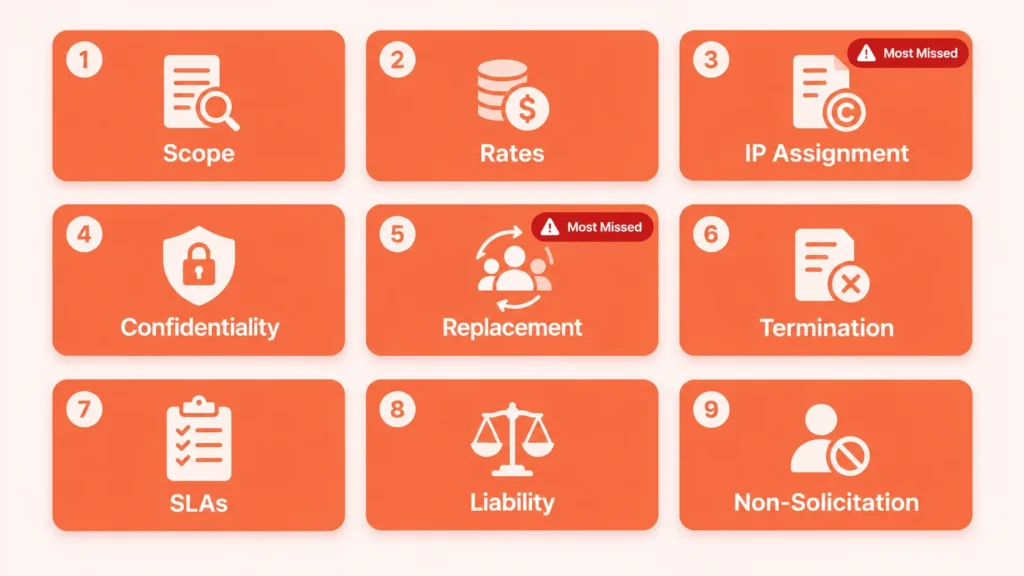
TL;DR: A staff augmentation contract has two layers: an MSA (Master Services Agreement) covering the overall relationship — IP, confidentiality, indemnification, termination — and a SOW (Statement of Work) activating each individual placement. The nine clauses that matter most are: scope of work, rates and payment, IP assignment, confidentiality, replacement guarantee, termination and offboarding, SLAs, liability and indemnification, and non-solicitation. IP assignment and replacement guarantee are the two most frequently missing or underspecified. Missing either creates legal exposure that no rate negotiation can offset.
Why Most Staff Augmentation Contracts Fail
The most common pattern in staff augmentation disputes is not bad engineering or missed deadlines — it is contract gaps. Zedtreeo’s 2026 review of offshore staffing disputes found three recurring failure modes: template inertia (a 2018-era SaaS contract applied to a 2026 staff augmentation engagement), asymmetric risk (vendor caps liability at one month of fees while the client’s downside on a failed engagement can be far larger), and missing clauses that only surface under pressure.
Most staff augmentation contracts are missing at least three of the nine clauses in this guide (Acquaint Softtech, March 2026). Each missing clause is a specific risk carried without knowing it.
“The single most common pattern in disputes is not bad work or missed deadlines. It is contract gaps. Buyers anchor on hourly rate and skip the clauses that determine what happens when reality diverges.” — Zedtreeo Legal Advisory, May 2026
The Two-Document Structure: MSA + SOW
A staff augmentation engagement runs on two documents:
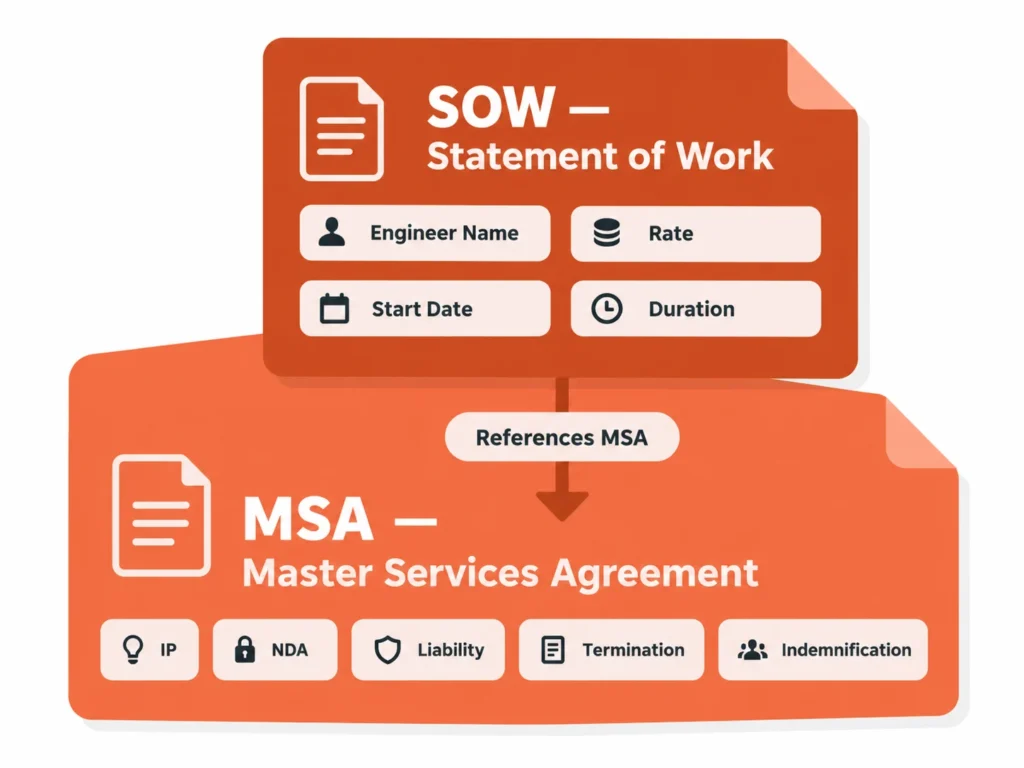
Master Services Agreement (MSA): Governs the overall relationship between your company and the provider. Covers IP ownership, confidentiality, indemnification, liability, governing law, dispute resolution, and termination. Negotiated once; applies to every placement. The MSA is where the expensive clauses live — negotiate it carefully because every contractor the provider places with you operates under its terms.
Statement of Work (SOW): Activates a specific placement. Specifies the engineer’s name and role, the bill rate, start date, duration, working hours, and any role-specific requirements. Created for each engagement; references the MSA for legal framework.
The SOW cannot fix a bad MSA. The termination terms, IP assignment, and indemnification agreed in the MSA apply to every SOW regardless of what the SOW says. Review the MSA with legal counsel before signing the first SOW.
Clause 1: Scope of Work — Define Who Directs the Work
What it covers: The scope clause defines what the provider will and will not do, the reporting structure, expected contribution, working hours, and whether this is staff augmentation (client-directed) or managed delivery (vendor-directed).
Why it matters: Staff augmentation and project outsourcing operate under entirely different legal and management frameworks. A contract that does not explicitly state the client directs the work leaves room for the vendor to claim managed-services pricing or to dispute accountability for outcomes the client expected the engineer to deliver.
What a strong clause says:
The Provider will supply one or more engineers ("Augmented Personnel")
as described in each SOW. The Client retains full direction and control
over the day-to-day work of Augmented Personnel, including task assignment,
sprint priorities, code review standards, and delivery methodology.
The Provider is responsible for employment, payroll, and compliance.
The Client is responsible for outcomes delivered under this engagement.
What to watch for: Language like “Provider will deliver [outcome]” or “Provider will manage the team to achieve [result]” signals the vendor is treating this as managed delivery, not augmentation. Strike and replace.
Clause 2: Rates, Billing Cycle, and Payment Terms
What it covers: The monthly or hourly rate for each role, billing cycle, payment terms, overtime policy, rate escalation, and expense reimbursement.
Why it matters: Rate disputes are the most common source of billing conflict. Pangea’s 2026 analysis found that not specifying whether rates include benefits, taxes, and equipment leads to 15–25% cost surprises.
What a strong clause specifies:
| Term | Strong position | Watch for |
|---|---|---|
| Rate | Monthly fixed per named engineer | Hourly with no monthly cap |
| Billing cycle | Monthly, 30 days from invoice | Weekly billing with 15-day terms |
| Payment method | ACH/wire, standard Net-30 | Cheque with Net-60 |
| Rate escalation | Capped at 5–8% annually, 60 days advance notice | Open-ended “rates may adjust” |
| Overtime | By mutual agreement, pre-approved in writing | Silent (creates surprise invoices) |
| Rate includes | Employment, payroll, equipment, workspace | Base rate only; additional fees for hardware, workspace, management |
At InApps: One monthly rate per engineer. No recruitment fee, no bench charge, no equipment surcharge. The rate covers employment, payroll, ISO 27001:2022-certified workspace, managed devices, and account management. Rate increases are annual, capped, and noticed in advance.
Clause 3: IP Assignment — The Most Important Clause
What it covers: Who owns code, documentation, designs, and inventions created during the engagement. When ownership transfers. What happens to pre-existing IP the provider’s engineers bring to the engagement.
Why it matters: Under most international jurisdictions, work created by an employee of a third-party provider does not automatically transfer to the client. The “work-for-hire” doctrine — which does make the client the default owner — is narrowly defined in US copyright law and not recognised in most EU and Latin American jurisdictions. Without an explicit assignment clause, the IP may vest in the provider, not in you.
The strongest formulation (from A&O Shearman’s IP capture guidance, cited by Cloud Employee 2026):
To the extent that any work product created under this Agreement
is not deemed a work made for hire, Provider and its personnel hereby
irrevocably assign all right, title, and interest in such work product
to Client, effective upon creation.
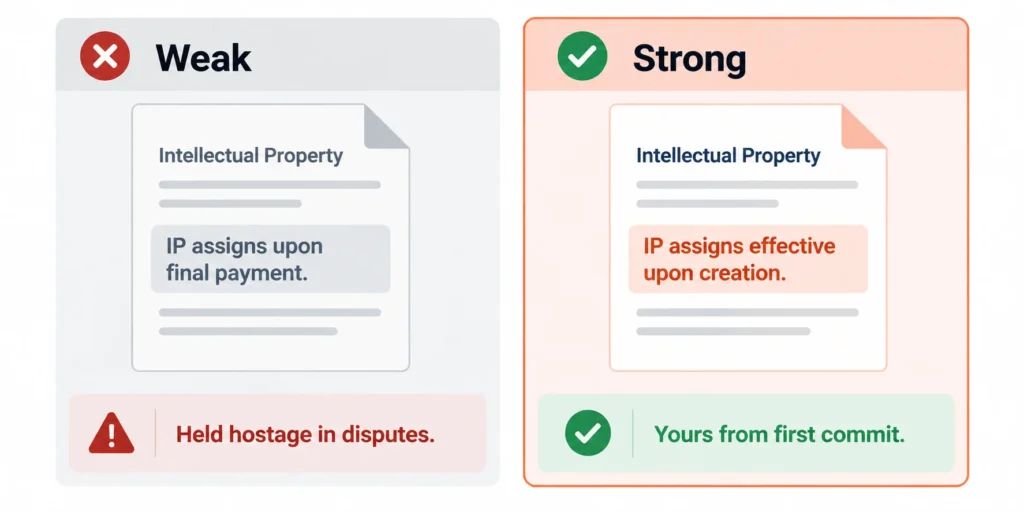
The key language: “effective upon creation” — not on final payment, not on contract end. Payment-conditioned assignment means the provider retains rights if you dispute an invoice. Founders heading into a funding round should be especially attentive: investors conducting due diligence will flag IP that transfers on payment rather than on creation.
Pre-existing IP: Require the provider to disclose any pre-existing IP (proprietary frameworks, libraries, tooling) that will be incorporated into your codebase before work begins. Pre-existing IP belongs to the provider; you should receive a perpetual, royalty-free licence to use it to the extent it is embedded in your deliverables.
Three things to verify:
- IP transfers on creation, not on final payment
- Clause names the governing jurisdiction’s assignment law specifically
- Pre-existing IP is identified and licensed (not silently transferred or withheld)
Clause 4: Confidentiality and NDA
What it covers: Definition of confidential information, obligations of both parties, survival period post-engagement, what happens to confidential materials when the engagement ends.
Why it matters: A generic mutual NDA clause that says “confidential information shall not be disclosed” without defining what counts as confidential, the survival period, or the remedies for breach provides limited protection. Source code, business logic, customer data, API credentials, product roadmaps, and commercial terms should all be explicitly named.
What a strong clause includes:
- Explicit definition of confidential information (name it; do not leave it to interpretation)
- Individual engineers bound separately — the NDA should require each placed engineer to sign a confidentiality agreement before their first day, not just the provider entity
- Survival period: 3–5 years post-engagement for standard confidential information; indefinitely for trade secrets
- Return/deletion obligations at engagement end with written certification
- Data handling: prohibition on uploading proprietary code or customer data to unsanctioned AI tools
At InApps: NDA is signed during the vetting process — before any engineer receives client codebase access. The obligation binds both InApps as the employing entity and the individual engineer. NDA survival extends past engagement end.
Clause 5: Replacement Guarantee
What it covers: The provider’s obligation to replace an underperforming or departing engineer, the timeline for replacement, quality criteria, and cost allocation.
Why it matters: Without a defined replacement clause, a mismatch in the first month leaves you with no contractual remedy. You absorb the ramp-up cost twice — once for the wrong engineer and once for the replacement — while the backlog accumulates.
What the clause must specify:
- Timeline: Maximum number of business days from flag to replacement profile. 5–7 business days is achievable for a pre-vetted bench. “As soon as reasonably practicable” is not a commitment.
- Cost: First replacement at no charge. Some contracts offer credit against future invoices — push for no-cost replacement outright.
- Coverage window: 30-day guarantee is standard. Some providers extend to 60–90 days.
- Trial restart: If the first placement is wrong, does the 30-day trial period restart for the replacement? It should.
- Quality criteria: Replacement must be of equivalent or higher seniority and matching technical stack.
At InApps: 30-day replacement guarantee, no cost, replacement sourced from the existing pre-vetted pool in 5–7 business days. Trial period restarts for the replacement. The sprint timeline does not move.
Clause 6: Termination and Offboarding
What it covers: Notice period for termination for convenience, conditions for immediate termination for cause, knowledge transfer obligations, and offboarding checklist.
Why it matters: Termination clauses determine your exit cost if the engagement does not work. A 90-day notice requirement for convenience termination means you pay three additional months if you decide to exit — regardless of the reason. Cloud Employee’s 2026 contract analysis identifies termination notice as the clause buyers most often accept without negotiation.
Two types of termination:
For convenience (no fault):
- 30 days’ notice is the standard. Two weeks is achievable with a strong provider.
- Avoid: 60–90 day requirements that double or triple your exit exposure.
- Any fee or penalty for termination for convenience is a red flag.
For cause (immediate):
- Security breach, deliberate IP theft, criminal conduct, material breach not cured within a defined period — should trigger immediate termination with no notice requirement.
- Avoid: contracts that blur for-cause and for-convenience, giving the vendor leverage to dispute every exit as a “for-cause” termination you must justify.
Offboarding checklist (build into the contract):
- Repository and system access revoked within 24 hours of final working day
- VPN credentials and SSO accounts deactivated
- Any shared API keys or credentials rotated
- Two-week knowledge transfer period: the departing engineer documents work in progress, open issues, and deployment instructions
- Written certification of data deletion from personal devices within 5 business days
- Final invoice settled and all financial obligations closed
At InApps: Two weeks’ notice for termination for convenience, either direction. No penalty for early exit after the initial term. Formal offboarding process managed by InApps account manager — access revocation, knowledge transfer, and data deletion certification included.
Clause 7: Service Level Agreements (SLAs)
What it covers: Performance benchmarks, onboarding timelines, response times, reporting cadence, and escalation procedures.
Why it matters: SLAs in a staff augmentation engagement are different from managed services SLAs. The client directs the work, so output SLAs belong on the client’s management process — not the vendor. Vendor SLAs should focus on what the provider controls: time to shortlist, time to replacement, account manager response time, and onboarding support.
Appropriate SLA targets for staff augmentation:
| SLA | Strong | Acceptable |
|---|---|---|
| Time to shortlist | 5 business days | 10 business days |
| Time to replacement | 5–7 business days | 10–14 business days |
| Account manager response | Same business day | Next business day |
| Onboarding support | Week 1 daily availability | As needed |
| Performance check-in | Monthly | Quarterly |
Avoid: SLAs that measure the engineer’s output velocity (sprint velocity, PR count, story points) — these are management metrics that belong in your internal process, not in the vendor contract. Penalising the vendor for output that your engineering lead directs creates perverse incentives and does not hold up in a dispute.
Clause 8: Liability, Indemnification, and Insurance
What it covers: Limitation of liability (typically capped at 12 months of fees paid), indemnification for employment law failures, data breaches, and IP infringement, and required insurance coverage.
Why it matters: Without a liability cap, the vendor carries uncapped financial exposure — which no rational provider will accept, and which makes the clause unenforceable in practice. Without explicit indemnification for employment law failures (worker misclassification, wage claims), the client absorbs liability for the vendor’s employment practices.
What the clause must cover:
Liability cap: 12 months of fees paid is the industry standard. Carve-outs for: confidentiality breach, IP infringement, and wilful misconduct (these should be uncapped or carry a higher sub-cap).
Provider indemnification covers:
- Employment-related claims by augmented staff (misclassification, unpaid wages, benefits claims)
- Tax liabilities from worker classification failures
- IP infringement from pre-existing IP the provider incorporated without disclosure
- Data breaches caused by provider-side security failures
Client indemnification covers:
- Instructions and materials the client provides to augmented staff
- Claims arising from the client’s own negligence or misconduct
Required insurance (minimum for IT engagements):
- Commercial General Liability: $1M per occurrence, $2M aggregate
- Professional Liability (E&O): $1M per occurrence
- Cyber Liability: $1M (required if engineers access your systems or customer data)
- Workers’ Compensation: statutory limits
Require the provider to name you as an additional insured on the general liability and professional liability policies, and to provide certificates of insurance before any engineer starts.
Clause 9: Non-Solicitation and Conversion Terms
What it covers: The provider’s right to prevent you from directly hiring their engineers, the conversion fee if you do, and the time period of the restriction.
Why it matters: Non-solicitation clauses are standard and reasonable — the provider invested in finding and vetting the engineer. What to negotiate is the fee structure and the time period.
Standard market terms (2026):
- Conversion fee: 11–25% of the engineer’s first-year salary (SecondTalent 2026 benchmarks)
- Restriction period: 12–24 months from end of engagement
- Fee reduction: some providers offer a lower or zero fee if the engagement runs its full agreed term
Negotiation levers:
- Push for a fee that declines over the engagement duration (e.g., full fee in month 1, 50% after 6 months, zero after 12 months)
- Require the fee to be calculated on Vietnam market salary, not US equivalent salary (significant difference for offshore placements)
- Confirm the restriction applies only to direct hire, not to hiring through a different agency
At InApps: Conversion-to-hire is supported and encouraged. Terms are disclosed upfront in the engagement agreement, not buried in an exhibit. The fee structure declines with engagement tenure.
The Consolidated Checklist
Use this before signing any staff augmentation contract.
MSA Checklist
- Scope of work explicitly states client directs the work (not vendor)
- Rates include all-in components — no undisclosed fees for equipment, workspace, or management
- Rate escalation capped and requires advance written notice
- IP assigns to client upon creation (not on final payment)
- IP clause names the governing jurisdiction’s assignment law
- Pre-existing IP identified and licensed to client
- NDA binds both the provider entity and each individual engineer separately
- NDA survival period specified (3–5 years minimum; indefinitely for trade secrets)
- Replacement guarantee: timeline (5–7 days), cost (zero), and trial restart specified
- Termination for convenience: 30 days’ notice maximum (two weeks preferred)
- Termination for cause: immediate, named conditions, no cure period required
- Offboarding checklist: access revocation, credential rotation, data deletion, knowledge transfer
- Liability cap: 12 months of fees paid, with carve-outs for confidentiality and IP
- Provider indemnifies for employment law failures and misclassification
- Insurance minimums confirmed: GL, E&O, Cyber Liability
- Non-solicitation: fee structure and restriction period negotiated and disclosed
SOW Checklist (per placement)
- Engineer’s name and role description
- Start date and anticipated duration
- Bill rate (monthly preferred) and billing cycle
- Working hours and timezone overlap commitment
- Overtime policy (mutual agreement required in writing)
- Internal manager named as directing authority
- Background check requirements for this specific role
- Access and equipment the client will provide vs. provider
- Specific security clearances or certifications required
Red Flags in a Provider’s Contract
| Red flag | What it signals | What to do |
|---|---|---|
| IP assigns “upon final payment” | IP held hostage during disputes | Strike; require “upon creation” |
| Liability capped at one month of fees | Provider not confident in their product | Push for 12-month cap |
| 90-day notice for convenience termination | Lock-in by design | Counter-propose 30 days |
| No replacement timeline specified | “We’ll try our best” is not a commitment | Require ≤7 business days in writing |
| “Work-for-hire” language only, no assignment clause | Work-for-hire does not apply in most non-US jurisdictions | Add fallback assignment clause |
| Confidentiality clause does not bind individual engineers | Engineer NDA is not enforceable against the person who holds your secrets | Require individual engineer sign-off |
| Open-ended rate escalation (“rates subject to market adjustment”) | You will be repriced at the vendor’s discretion | Cap to 5–8% annually with 60 days’ notice |
| No data deletion obligation at engagement end | Former engineers may retain your code indefinitely | Add explicit deletion + written certification |
How InApps Structures Its Contracts
InApps operates on a transparent MSA + SOW structure. Here is where InApps lands on each of the nine clauses:
| Clause | InApps position |
|---|---|
| Scope / direction | Client directs. InApps handles employment. Stated explicitly in MSA. |
| Rates | Monthly all-in. No hidden fees. Annual cap, 60 days’ notice. |
| IP | Assigned to client upon creation. Jurisdiction-specific language. No pre-existing IP without disclosure. |
| Confidentiality | NDA binds InApps entity + each engineer individually. Signed in vetting, before codebase access. |
| Replacement | 30-day guarantee. 5–7 business days. No cost. Trial restarts. |
| Termination | 2 weeks’ notice for convenience. Immediate for cause. Formal offboarding managed by InApps. |
| SLAs | 5-day shortlist. 5–7-day replacement. Account manager same-day response. Monthly check-ins. |
| Liability | 12-month cap. Carve-outs for IP and confidentiality. Provider indemnifies employment law failures. |
| Non-solicitation | Disclosed upfront. Fee declines with engagement tenure. |
Get the engagement agreement reviewed before you sign anything. Book a 30-minute call → — we will walk through every clause in the InApps MSA in plain language before any commitment.
Frequently Asked Questions
What should a staff augmentation contract include?
Nine essential components: scope of work (stating the client directs the work), rates and payment terms, IP assignment (on creation, not on payment), confidentiality binding both the provider entity and individual engineers, replacement guarantee with a specific timeline and cost, termination for convenience and for cause, SLAs, liability and indemnification, and non-solicitation and conversion terms. IP assignment and replacement guarantee are the two most frequently underspecified.
Who owns the IP in a staff augmentation engagement?
The client should — but this requires an explicit assignment clause in the contract. Work-for-hire doctrine does not apply in most EU and Latin American jurisdictions. The contract needs a present-tense assignment clause (“hereby assigns all right, title, and interest… effective upon creation”) as a fallback for any work not classified as work-for-hire. Payment-conditioned assignment creates ambiguity that investors flag in due diligence.
What is a reasonable notice period for ending a staff augmentation engagement?
30 days is the industry standard for termination for convenience. Two weeks is achievable with providers who maintain a pre-vetted bench and do not need time to staff replacement engagements. Anything above 30 days is vendor-favorable and worth pushing back on. Immediate termination (no notice) should be available for cause events: security breach, IP theft, criminal conduct.
What is the standard conversion fee for hiring an augmented engineer directly?
11–25% of the engineer’s first-year salary, per SecondTalent’s 2026 staffing benchmarks. The fee typically applies for 12–24 months after the end of the engagement. Negotiate for a declining structure — lower fee after 6 months of engagement, zero after 12 months. For offshore placements (Vietnam), confirm the fee is calculated on Vietnam market salary, not US equivalent.
What is the difference between an MSA and an SOW in staff augmentation?
The MSA governs the overall relationship between your company and the provider — IP, confidentiality, indemnification, termination, and liability. Negotiated once; applies to every placement. The SOW activates a specific placement — naming the engineer, role, rate, start date, and duration. The MSA is where the expensive clauses live; the SOW is where the placement-specific economics are set. A bad MSA cannot be fixed by a good SOW.
How should IP assignment be worded in a staff augmentation contract?
Use present-tense language: “Provider and its personnel hereby irrevocably assign all right, title, and interest in all work product created under this Agreement to Client, effective upon creation.” Add a moral rights waiver where applicable (particularly for EU jurisdictions). Include jurisdiction-appropriate assignment law by name, not just in the general governing law provision. Require pre-existing IP to be identified and licensed — not silently transferred or withheld.
Key Takeaways
- Two documents: MSA (overall relationship) + SOW (each placement). Never sign a SOW without a fully negotiated MSA.
- IP assignment must say “effective upon creation” — not “upon final payment.” This is the single most consequential clause.
- Replacement guarantee must specify: timeline (≤7 business days), cost (zero), and whether the trial restarts for the replacement.
- Termination for convenience: 30 days maximum; push for 2 weeks. No penalty clauses.
- Liability cap: 12 months of fees paid, with carve-outs for IP infringement and confidentiality breach.
- NDA must bind individual engineers separately — not just the provider entity.
- Conversion fees (11–25% of first-year salary) are standard and negotiable. Negotiate declining structures based on engagement tenure.
- Most contracts are missing at least 3 of these 9 clauses — each is a specific risk carried without knowing it.
Work with us
Need a team that can do this on your codebase?
Tell us what you are shipping and we will send back a scope, a team shape and a fee. No obligation.
Book a free call