
On this page
TL;DR: IT staff augmentation for a senior engineer runs $15–$55/hour offshore and $120–$200/hour onshore in the US — a 4–8x gap. At full-time monthly rates, senior offshore engineers cost $8,000–$10,000/month all-in versus $18,000–$32,000/month onshore. Geography is the single biggest cost driver. Seniority, stack rarity, engagement length, and hidden costs move the final number from there.
What Does IT Staff Augmentation Actually Cost in 2026?
IT staff augmentation pricing has three layers most quotes do not show: the headline rate, the total cost of the placement (ramp-up loss, management overhead, replacement risk), and the comparison against what you would spend hiring the same person locally. Understanding all three is the difference between a quote that looks cheap and an engagement that actually is.
The clearest benchmark comes from the InApps service page, which cites the 2026 Vietnam market range for senior engineers at $30–$50/hour — against $120–$200/hour for equivalent roles in the United States. That 4x gap is where the economics of offshore augmentation start, and several factors move it up or down from there.
“A cheaper hourly rate does not necessarily mean a cheaper project — a junior developer who needs three times the hours and triggers rework from your senior engineer can easily cost more in total than a senior hire billed at double the rate.” — Zenkins Engineering Intelligence, August 2026
IT Staff Augmentation Rates by Region (2026)
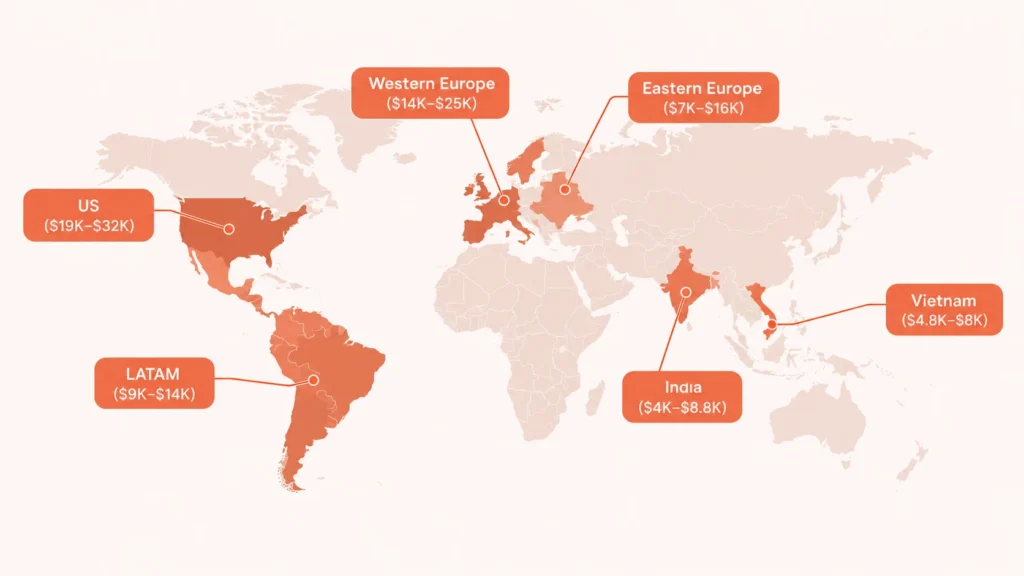
Geography is the dominant cost driver. The table below shows 2026 market ranges for a senior full-stack developer across the major sourcing regions.
| Region | Senior Developer Rate | Monthly (Full-Time) | Notes |
|---|---|---|---|
| United States | $120–$200/hr | $19,200–$32,000 | Zero timezone friction for US clients; highest cost |
| Western Europe | $90–$160/hr | $14,400–$25,600 | Strong quality; GDPR-native; high cost |
| Eastern Europe (Poland, Ukraine, Romania) | $45–$100/hr | $7,200–$16,000 | Strong engineering depth; good EU overlap |
| Latin America | $60–$90/hr | $9,600–$14,400 | Nearshore advantage for US; real-time overlap |
| India | $25–$55/hr | $4,000–$8,800 | Largest English-speaking senior pool; best volume |
| Vietnam / Southeast Asia | $15–$45/hr | $2,400–$7,200 | Comparable quality to India; smaller senior bench |
Sources: Zenkins rate benchmarks Aug 2026, Mismo.team cost guide 2026, InApps service page
What this means in practice: For the cost of one US onshore senior engineer ($19,200–$32,000/month), you can place two to three senior Vietnam-based engineers through a provider like InApps — with full-time dedication, your tools, and your tech lead directing the work.
IT Staff Augmentation Rates by Seniority (2026)
Within any region, seniority is the second-largest driver. The ranges below cover the global market.
| Seniority | Global Rate (USD/hr) | Vietnam/SEA (USD/hr) | India (USD/hr) |
|---|---|---|---|
| Junior (0–2 yrs) | $15–$35 | $15–$22 | $16–$22 |
| Mid-level (2–5 yrs) | $30–$65 | $20–$32 | $24–$34 |
| Senior (5–8 yrs) | $45–$90 | $30–$50 | $35–$48 |
| Lead / Architect (8+ yrs) | $60–$150 | $45–$65 | $50–$65 |
Source: Zenkins Pricing Guide 2026, InApps published market range
The seniority trap: Junior rates look attractive on paper but rarely deliver lower total cost. A junior engineer producing at 50–60% of senior throughput, requiring senior review time on every PR, and introducing rework costs more per unit of shipped output than a senior hire at twice the rate. Most engineering leads who have run both configurations switch to senior-only augmentation by the second engagement.
IT Staff Augmentation Rates by Specialisation (2026)
Stack rarity adds a premium regardless of region. Roles in AI/ML, security, and niche cloud infrastructure command rates above the general senior band even at offshore locations.
| Specialisation | Premium over base senior rate |
|---|---|
| AI / ML engineers | +30–60% |
| Cybersecurity specialists | +25–50% |
| Cloud architects (AWS/GCP/Azure) | +20–40% |
| Blockchain / Web3 | +30–55% |
| Embedded / IoT | +20–35% |
| React / Node.js (common stack) | 0–10% (at base senior rate) |
| Python / Django | 0–10% |
| DevOps / SRE | +15–25% |
According to IDC 2026, AI/ML engineers and cybersecurity specialists are the two hardest roles to fill globally — demand exceeds supply in every sourcing region, which drives the premium even at offshore rates.
The Four Pricing Models and When to Use Each
Most providers offer some combination of four billing structures. The right one depends on how well your scope is defined at the start.
| Pricing Model | Structure | Best When | Watch Out For |
|---|---|---|---|
| Time & Materials (hourly) | Per hour billed | Short-term, variable scope | Hours can drift; track weekly |
| Monthly retainer (per engineer) | Fixed monthly per FTE | Ongoing product work; 3+ months | Confirm what is included beyond hours |
| Dedicated team (pod) | Monthly retainer for 3–8 person team | Full product squad needed | Larger commitment; vet each role |
| Fixed-price project | Quoted per defined scope | Clear deliverables, bounded work | Changes trigger renegotiation |
For most engineering augmentation, monthly retainer per engineer is the default — transparent, predictable, no bench charges, and scalable on two weeks’ notice. The fixed-price model suits bounded output (a migration, a specific integration); it breaks down when the roadmap changes, which is most of the time.
Hidden Costs Nobody Puts on the Rate Card
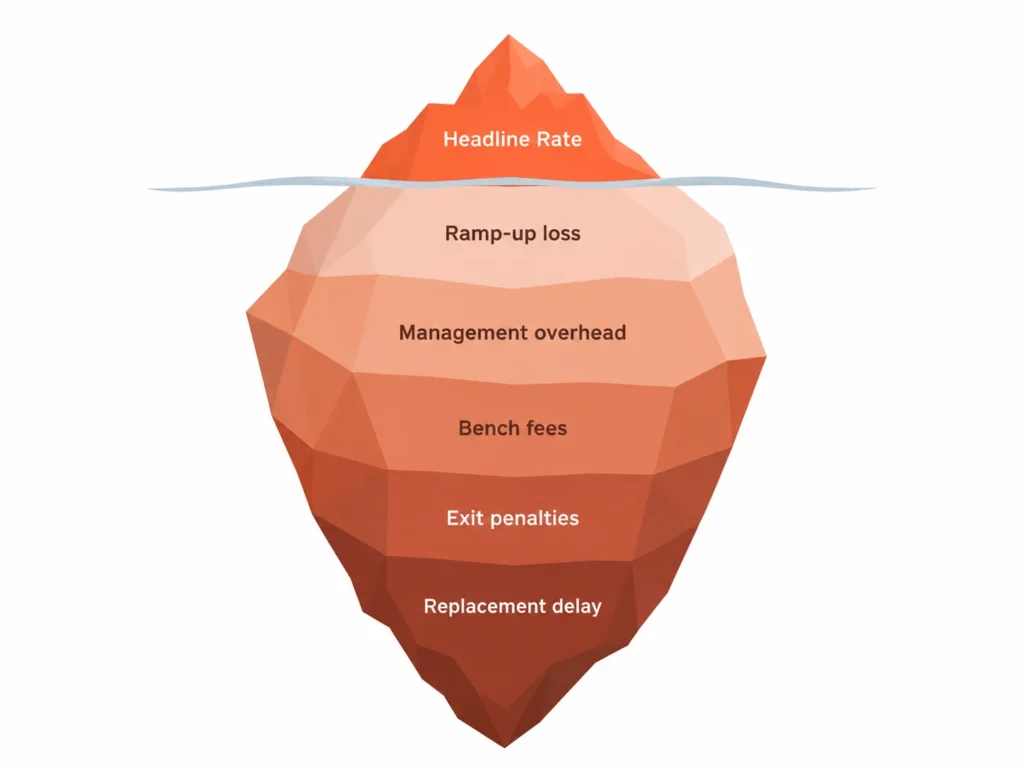
The headline rate is the starting point, not the total cost. Five factors reliably inflate the real number:
1. Ramp-up productivity loss. A new engineer takes time to become fully productive. Low-quality providers see 30–35% effective productivity loss in month one from engineers who were not genuinely pre-vetted. Well-vetted engineers (four-stage process, stack-matched before placement) run closer to 10–12% loss. On a $8,000/month engagement, that difference is $1,760–$2,400 in effective month-one output.
2. Management overhead. Engineers who need constant direction, unblocking, and PR re-review consume your senior team’s time. The rule of thumb: one poorly-matched engineer requires 4–6 hours/week of senior oversight. At $150/hour internal senior time, that is $2,400–$3,600/month of invisible cost not on the invoice.
3. Minimum term and exit clauses. Some contracts lock 3–6 month minimums with penalty clauses for early exit. Others require 60–90 days’ notice to scale down. At InApps, the notice period is two weeks in either direction — no minimum term beyond the initial agreed period.
4. Bench fees. Some providers charge for time between placements or during transition periods. Verify explicitly: is pricing strictly per placed, active engineer? A bench charge on a $8,000/month rate can add $1,500–$2,000/month for engineers not yet in your sprint.
5. Replacement cost. When an engineer leaves or is not a fit, most providers take 4–8 weeks to backfill — during which you carry the vacancy cost. Providers with a 30-day replacement guarantee, sourcing from a pre-vetted pool, reduce this to 5–7 business days.
Total Cost of Ownership: Augmentation vs In-House Hire
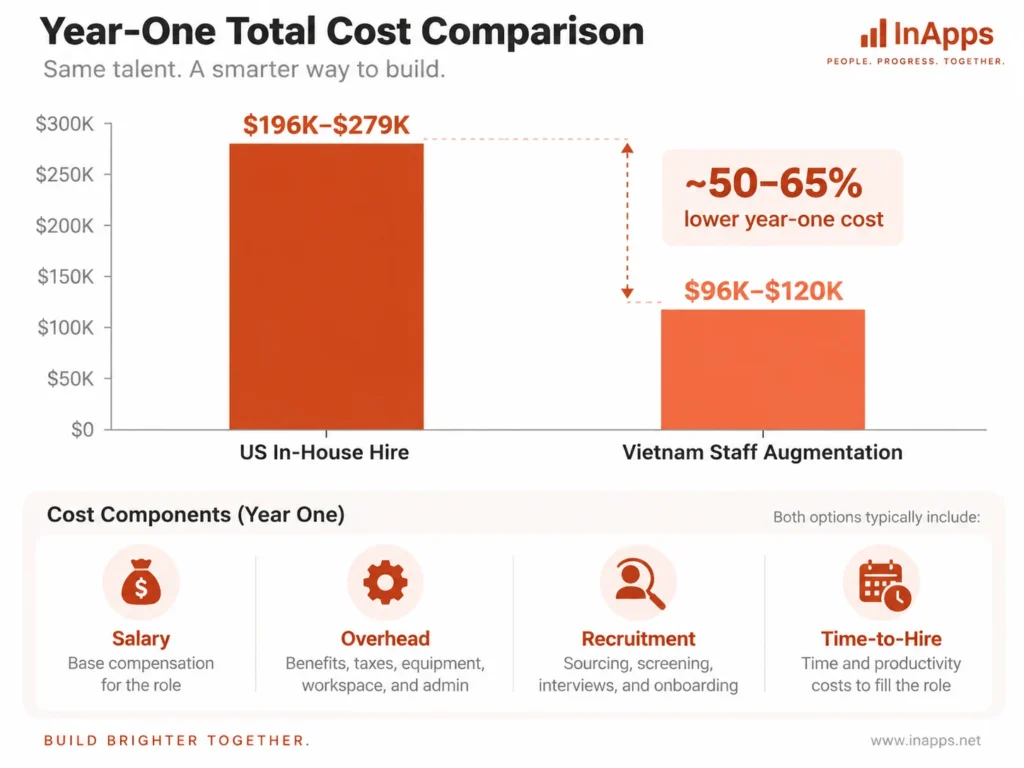
Augmentation is often compared to hiring, but the comparison is rarely done on the same terms. The table below uses a senior full-stack engineer as the benchmark.
| Cost Component | In-House Hire (US) | Staff Augmentation (Vietnam, senior) |
|---|---|---|
| Annual base salary | $140,000–$180,000 | — |
| Employer overhead (benefits, payroll tax, equity) | +30–40% = $42K–$72K | — |
| Recruitment cost (agency fee) | $14,000–$27,000 one-time | None |
| Time to first commit | 3–4 months | 1–2 weeks |
| Total year-one cost | $196K–$279K | ~$96K–$120K all-in |
| Flexibility | Rigid headcount process | 2 weeks’ notice either way |
| Replacement if wrong fit | 3–6 month re-hire | 5–7 business days |
| IP ownership | Yours | Yours from first commit |
Salary data: US Bureau of Labor Statistics 2026. Augmentation rate: InApps Vietnam senior market range $30–50/hr × 160hrs × 12 months
Staff augmentation avoids recruitment fees, employer overhead (typically 25–40% on top of salary), and the 3–4 month hiring cycle. The gap on year-one total cost is typically 40–60% in augmentation’s favour for offshore sourcing.
What InApps Charges and How Pricing Works
InApps does not publish a rate card, because the honest answer depends on seniority, stack, and engagement length — and a number quoted without knowing those is a guess. What we do publish: the 2026 Vietnam market range for senior engineers is $30–$50/hour, and every engagement is scoped individually with a written proposal after a 30-minute discovery call.
What the monthly rate covers at InApps — with no additional line items:
- Four-stage vetting (3% of applicants pass — live coding, system design, English assessment, panel review)
- Employment, payroll, and Vietnamese labour compliance
- ISO 27001:2022-certified workspace, devices, and access controls
- Performance check-ins every four weeks
- 30-day replacement guarantee at no cost, replacement sourced in 5–7 business days
- Two weeks’ notice to scale in either direction; no minimum term trap
“Quality engineers, proposed within days. But what actually made the difference was the culture fit — they worked like they were part of our team from day one.” — Engineering Leader, Future Processing (InApps client)
To get a scoped cost range for your role and stack: Talk to a Solutions Consultant → — no pitch, no discovery invoice, matched profiles within five days.
Frequently Asked Questions
How much does IT staff augmentation cost per hour in 2026?
Hourly rates range from $15–$45/hour for Vietnam and Southeast Asia, $25–$55 for India, $45–$100 for Eastern Europe, $60–$90 for Latin America, and $120–$200 for onshore US roles. The range within each region is driven by seniority — junior engineers at the low end, lead/architect roles at the high end. A “cheap” quote at the junior low end rarely delivers lower total cost once ramp-up loss and rework are counted.
What is the monthly cost of one IT staff augmentation engineer?
A full-time senior engineer on a monthly retainer runs approximately $4,000–$8,800/month for India-based talent and $4,800–$8,000/month for Vietnam-based talent at market rates. US onshore runs $18,000–$32,000/month. The monthly all-in figure from InApps for a senior engineer falls within the $30–$50/hour market range for Vietnam, totalling approximately $4,800–$8,000/month at full-time hours.
Is IT staff augmentation cheaper than hiring in-house?
For short to medium-term needs, yes — typically 40–60% cheaper on a year-one total cost basis for offshore augmentation versus a US in-house hire. Augmentation avoids the one-time recruitment fee ($14,000–$27,000), employer overhead (30–40% on top of salary), and the 3–4 month time-to-first-commit. The comparison narrows for 2+ year engagements, at which point a dedicated team model often delivers better economics.
What are the hidden costs in IT staff augmentation?
The five most common: ramp-up productivity loss (10–35% of month-one output depending on vetting quality), management overhead if engineers need constant direction, minimum-term and exit penalties in some contracts, bench fees between placements, and replacement delays when a fit is wrong. A provider with a four-stage vetting process, 30-day replacement guarantee, and two weeks’ notice policy eliminates most of these.
How does engagement length affect IT staff augmentation cost?
Longer commitments consistently earn lower effective rates from most providers. A 12-month engagement will typically price 10–20% below a rolling monthly arrangement. It also reduces ramp-up costs as a percentage of total spend — a one-month ramp-up on a six-month engagement costs proportionally twice what it costs on a twelve-month one.
What is included in the monthly rate vs billed separately?
This varies significantly by provider. At InApps, the monthly rate includes vetting, employment, payroll, compliance, workspace, equipment, account management, and the 30-day replacement guarantee — with no recruitment fee, bench charge, or minimum-term penalty. Ask any provider to enumerate exactly what is and is not in the monthly number before comparing quotes.
How do you evaluate whether an augmentation rate is fair?
Compare on total cost of ownership, not the headline hourly rate. Ask: what is the vetting process and pass rate? What is the ramp-up timeline and productivity in month one? Is there a replacement guarantee, and how long does replacement take? What are the exit terms? A rate 30% lower than market with no vetting process, a 4–6 week replacement timeline, and a 90-day exit clause is not a cheaper engagement — it is a more expensive one that takes longer to find out.
Key Takeaways
- Senior offshore augmentation runs $15–$55/hour ($2,400–$8,800/month); US onshore runs $120–$200/hour ($19,200–$32,000/month) — a 4–8x gap.
- Geography is the single biggest cost driver. Seniority is second.
- AI/ML and security specialists command +30–60% above base senior rates in any region.
- Hidden costs — ramp-up loss, management overhead, bench fees, replacement delays — can add 30–50% to a low headline rate.
- Year-one total cost: offshore augmentation typically runs 40–60% below an equivalent US in-house hire when all costs are counted.
- Always compare on total cost of ownership — vetting quality, replacement speed, and exit terms — not the hourly number alone.
Work with us
Need a team that can do this on your codebase?
Tell us what you are shipping and we will send back a scope, a team shape and a fee. No obligation.
Book a free call