
On this page
TL;DR: Staff augmentation rents team capacity — you direct the engineers, own the process, and keep all IP from the first commit. Outsourcing buys a deliverable — the vendor manages execution, you review outputs at milestones. They fail in different ways: augmentation fails without internal technical leadership; outsourcing fails when scope changes. Gartner’s 2024 Workforce Strategies survey found organisations using a deliberate mix of both achieved 30% higher project delivery rates than those committed to either model exclusively.
The One Question That Separates the Two Models
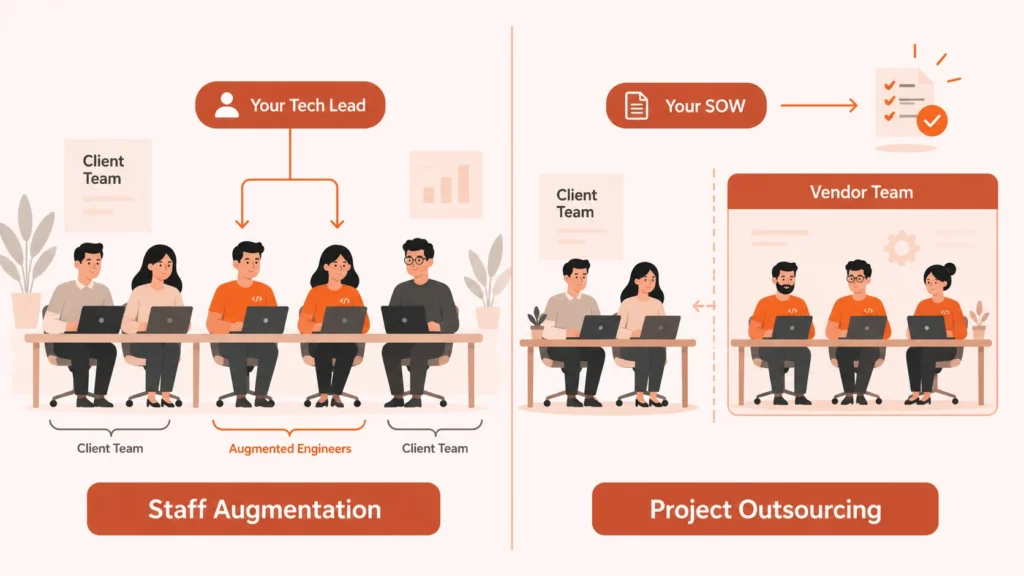
Every useful comparison between staff augmentation and outsourcing starts with the same question: who manages the engineers day-to-day?
In staff augmentation, your engineering lead manages the engineers. They sit in your Slack, attend your standups, commit to your repos, take tickets from your backlog. The vendor provides the people and handles HR, payroll, and replacement. You provide the direction, the architecture, and the accountability for outcomes.
In project outsourcing, the vendor’s PM manages the engineers. You write a spec or statement of work; the vendor staffs the project, runs their own delivery process, and ships you a working artifact at agreed milestones. You manage the vendor relationship, not the engineering team.
That distinction determines everything else — pricing, IP ownership, scope flexibility, exit cost, and what happens to the code when the engagement ends.
“Outsourcing buys a project. Staff augmentation builds a team. Most software work is the second thing. Make sure you’ve named which one you’re actually buying.” — FullScale Engineering Intelligence, 2026
Side-by-Side Comparison: Staff Augmentation vs Outsourcing
| Dimension | Staff Augmentation | Project Outsourcing |
|---|---|---|
| Who owns delivery outcomes | You | Vendor (under SOW/SLA) |
| Who manages engineers daily | Your engineering lead | Vendor’s PM |
| IP ownership | Yours from first commit | Negotiated in SOW; usually on delivery |
| Who writes specs | You (tickets, designs, ADRs) | You write high-level SOW; vendor fills detail |
| Time to first contribution | 1–2 weeks | 4–8 weeks (discovery + spec + ramp) |
| Scope flexibility | High — redirect any sprint | Low — changes trigger renegotiation |
| Pricing model | Hourly or monthly per engineer | Fixed bid, T&M, or milestone-based |
| Exit cost | Low — 2 weeks’ notice typical | High mid-project — handoff, knowledge gap |
| Quality visibility | Immediate — you review every PR | At delivery — can be too late |
| Knowledge at engagement end | Stays in your team | Walks out with the vendor’s engineers |
| Vendor lock-in risk | Low — engineers are swappable | High — undocumented vendor code is hard to rebuild |
| Management overhead on your side | 15–25% of tech lead time per engineer | Low — you review milestones only |
| Budget certainty | Variable (scales with time) | High for fixed-bid; volatile with change orders |
| Best for | Core product, ongoing, evolving scope | Scoped deliverable, non-core, clear acceptance criteria |
| Fails when | No internal tech lead to direct work | Scope changes; requirements were unclear |
When Staff Augmentation Wins
Staff augmentation is the right model when the work is core, ongoing, and the scope will evolve. Four conditions make it the stronger choice:
1. The code is your competitive moat. If what is being built sits at the centre of your product’s differentiation — proprietary algorithms, the customer data layer, your core workflow — you want engineers committing directly to your repos, under your code review, with IP that flows to you from the first line. Outsourcing introduces a vendor company between your IP and the engineer. Second Talent’s 2026 analysis, citing Gartner’s IT Sourcing Framework, identifies direct repo access as the defining governance feature of staff augmentation for IP-sensitive workloads.
2. The roadmap will change. In project outsourcing, every scope change is a contract amendment. Codersera’s 2026 CTO Decision Guide estimates that change orders account for 15–30% of original SOW value in most non-trivial software projects. In augmentation, you re-prioritise the backlog on Monday; the engineers follow. For products in active development, augmentation’s flexibility eliminates the cost and delay of scope renegotiation.
3. Knowledge needs to stay. When the outsourcing engagement ends, the vendor’s engineers move to the next client. The knowledge they built about your architecture, your deployment decisions, your edge cases — gone, unless an explicit knowledge transfer was built into the contract. Augmented engineers work inside your team throughout the engagement. The code and the context stay because they were never elsewhere.
4. Ongoing product development runs past six months. GYSP Technology’s 2026 framework analysis finds that for continuous product engineering — no natural completion point, growing complexity — augmentation consistently outperforms outsourcing on total cost past month six. Monthly billable rates look higher than fixed-bid project invoices until you count scope changes, re-onboarding on each new project, and post-delivery rework.
When Outsourcing Wins
Project outsourcing earns its place on bounded, well-specified work where vendor accountability for delivery is more valuable than internal control of the process.
1. The scope fits on one page. A marketing site rebuild. A Salesforce integration. A SAML SSO implementation. A mobile v1 for a platform that already has a web product. When acceptance criteria are objective and scope is genuinely unlikely to change, outsourcing’s fixed-bid model provides budget certainty that augmentation cannot. Emerald Labs’ 2026 model comparison finds outsourcing is typically cheaper in absolute dollars for contained, one-time builds with no ongoing maintenance requirement.
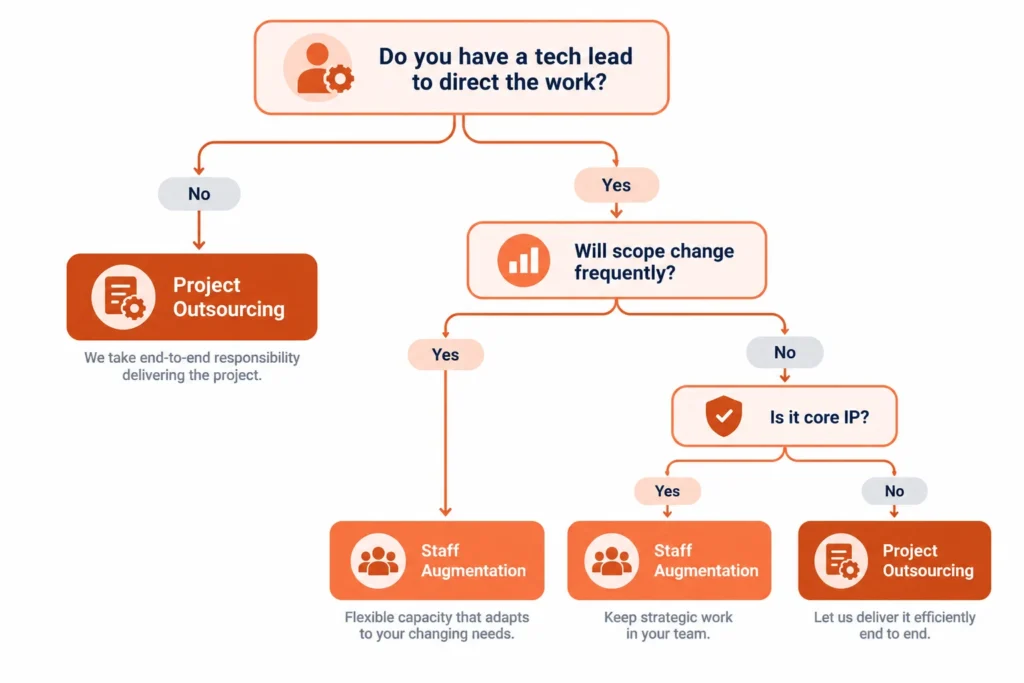
2. You do not have engineering leadership to direct the work. This is the gate question for augmentation. FullScale’s 2026 analysis is direct: “If you don’t have a CTO, a tech lead, or anyone who can direct developers on a day-to-day basis, staff augmentation will not work for you. The developers will show up, sit there waiting for clarity that never comes, and you’ll burn cash watching it happen.” If internal technical leadership does not exist or is fully allocated, outsourcing removes the management burden entirely.
3. The deliverable is non-core. Work that runs outside your product’s core — an internal admin tool, a data migration, a third-party integration — is a candidate for outsourcing. You want the outcome, not the process. A well-run outsourcing engagement delivers the artifact to spec, transfers IP, and closes. Your team takes it from there.
4. You need a complete cross-functional team immediately. Outsourcing vendors assemble a full squad — engineers, QA, PM — faster than augmentation builds one role at a time. For a bounded initiative requiring immediate capacity across multiple functions, outsourcing’s team assembly is faster than augmenting individual specialists sequentially.
The Hybrid That Works Best
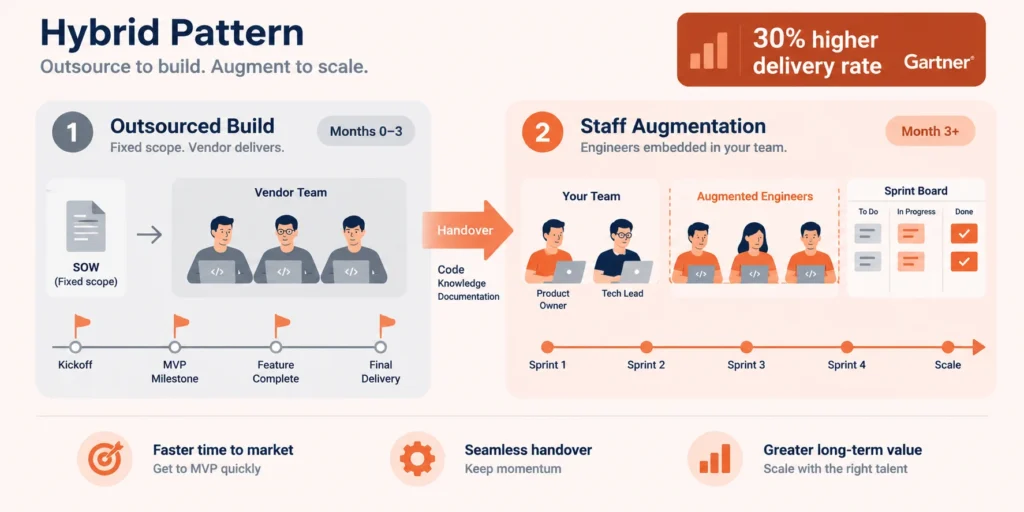
Gartner’s 2024 Workforce Strategies for Technology Leaders survey found organisations using a deliberate mix of augmentation and outsourcing achieved 30% higher technology project delivery rates than those committed to either model exclusively. The mechanism is model-to-task alignment: outsourcing for self-contained deliverables, augmentation for knowledge-intensive, evolving workloads.
The most effective pattern for growth-stage technology companies:
Core product (augmentation): Engineers from InApps embedded in your team, long-tenure, reviewing PRs your way, building institutional context month over month.
Scoped deliverables (outsourcing): Marketing sites, niche integrations, one-time builds where clear acceptance criteria can be written — outsourced fixed-bid to specialist vendors who own delivery risk.
Transition path: Outsource the initial build of a new product area under a defined scope → augment engineers in for ongoing enhancement once it is live. The outsourced phase delivers under vendor accountability; the augmented phase builds internal ownership.
Cost Comparison: What the Numbers Actually Show
The fixed-bid invoice looks cheaper than a monthly rate card until you count the complete cost structure.
| Cost element | Staff Augmentation | Project Outsourcing |
|---|---|---|
| Pricing | Monthly per engineer ($4,800–$8,000 for Vietnam senior) | Fixed bid or T&M per project |
| Management overhead | 15–25% of tech lead time (your cost) | Minimal — vendor handles it |
| Discovery/spec phase | None — engineers start on existing backlog | $20,000–$50,000 before code is written |
| Change order cost | None — reprioritise the backlog | 15–30% of original SOW value (industry rule of thumb) |
| Knowledge transfer at end | None — knowledge stays in your team | 15–25% of contract value for structured handover |
| Post-delivery rework | Rare — you reviewed every PR | Common — vendor optimised for spec, not context |
| Better for | Ongoing work (6+ months) | One-time scoped build |
| Total cost winner | Ongoing product work | Clearly bounded single deliverable |
Codersera’s 2026 analysis finds that for a 6-month, 3-engineer capacity gap on core product, augmentation runs 20–40% cheaper than equivalent fixed-bid delivery when hidden costs are honestly counted — assuming internal management bandwidth exists. When it does not, that calculation reverses.
Red Flags in Each Model
| Model | Red Flag | Why It Matters |
|---|---|---|
| Augmentation | No internal tech lead available to direct work | Engineers wait for direction; management cost erodes all savings |
| Augmentation | Provider cannot shortlist in under 1 week | Not a pre-vetted bench — sourcing from scratch |
| Augmentation | No 30-day replacement guarantee | Vacancy risk after a mismatch lands entirely on you |
| Outsourcing | Scope defined loosely in the SOW | Change orders will inflate the fixed bid 20–40% |
| Outsourcing | No IP assignment clause specifying transfer on creation | IP ambiguity at handover; potential disputes |
| Outsourcing | No explicit knowledge transfer phase in the contract | Code arrives as a black box your team cannot maintain |
| Both | Provider uses “augmentation” and “outsourcing” interchangeably | They are selling one model with two labels |
How InApps Runs Both Models
InApps offers both — and will tell you which one fits your situation on the first call, including when neither is right.
IT Staff Augmentation: Named senior engineers embedded in your sprint in 1–2 weeks. They report to your engineering lead, commit to your repository, and follow your definition of done. 3% of applicants pass the four-stage vetting process. IP assigned from the first commit. Two weeks’ notice to scale in either direction. 92% of engineers still on the same account at 12 months. 94% of clients re-engage.
Software Product Development: Fixed scope, fixed price, fixed delivery date — we carry the delivery risk. Discovery, architecture, design, build, QA, and launch under one contract. The scope is written down before anyone opens an editor. Changes go through a change request with a price and a date, agreed in writing before any work starts. IP assigned from the first commit. Thirty days of hypercare after launch with the same engineers.
The difference in InApps’ own portfolio: augmentation clients have a clear roadmap and need execution velocity on their core product. Software Product Development clients need a bounded build delivered to spec — a new product line, an MVP, a platform integration — with InApps carrying the delivery accountability.
“They don’t just build what you ask for. They think about the end result, and then go beyond it.” — James Fitzgerald, CTO, Computer Software Company (InApps client)
750+ projects delivered. 85%+ multi-year client retention. 4.9/5 on Clutch from 50+ verified reviews.
Not sure which model fits? Book a 30-minute discovery call → — we will map the right structure and tell you plainly if augmentation, software product delivery, or something else fits your situation.
Frequently Asked Questions
What is the difference between IT staff augmentation and outsourcing?
Staff augmentation adds named engineers to your team under your management — you own the process, the backlog, and all IP from the first commit. Outsourcing hands a defined scope to a vendor who manages delivery and is accountable for the outcome under an SOW. The core difference is who manages the engineers daily and who owns delivery outcomes: with augmentation, you do; with outsourcing, the vendor does.
Which is cheaper: staff augmentation or outsourcing?
Neither is categorically cheaper — it depends on scope and duration. For ongoing product work past six months, augmentation typically runs 20–40% cheaper than equivalent outsourced delivery when hidden costs (discovery phase, change orders, knowledge transfer at handover) are counted. For clearly bounded one-time builds with stable scope, outsourcing’s fixed bid is usually cheaper in absolute dollars. The mistake is comparing monthly rates to project invoices without counting complete cost structures on both sides.
When should you use staff augmentation instead of outsourcing?
Use augmentation when the work is core product, the scope will evolve, you have internal technical leadership to direct the engineers, and the institutional knowledge needs to stay in your team. Use outsourcing when the scope is clearly defined and unlikely to change, you need vendor accountability for delivery, you lack the bandwidth to manage external engineers directly, and the work is non-core or bounded by a clear completion point.
Can you use staff augmentation and outsourcing together?
Yes — and Gartner’s 2024 Workforce Strategies survey found organisations using a deliberate mix achieved 30% higher project delivery rates than those committed to either model exclusively. The effective pattern: augmentation for core ongoing product development; outsourcing for bounded deliverables outside the core. Outsource the initial build of a new area, then augment engineers in for ongoing enhancement once it is live.
Who owns IP in staff augmentation vs outsourcing?
In staff augmentation, IP is yours from the first commit — engineers commit directly to your repository under your access controls, and IP assignment flows automatically under work-for-hire provisions. In outsourcing, IP ownership must be explicitly negotiated in the SOW and typically transfers at delivery or on payment milestones. Without a clear “work made for hire” or assignment clause reviewed by legal counsel, the vendor technically retains rights until the dispute resolves.
What happens to code knowledge when each engagement ends?
With augmentation, knowledge stays — it was built inside your team, by engineers working alongside your people, documented in your systems. With outsourcing, knowledge leaves with the vendor’s engineers at project close unless an explicit knowledge transfer phase was contracted. GYSP Technology (2026) identifies knowledge retention as the primary factor in choosing augmentation over outsourcing for any workload where internal team capability is a success criterion.
Key Takeaways
- Staff augmentation: you manage the engineers. Outsourcing: the vendor manages the engineers. Everything flows from that single difference.
- Gartner 2024: organisations using both models deliberately achieved 30% higher delivery rates than those committed to either exclusively.
- Augmentation is cheaper for ongoing work (6+ months) — 20–40% vs equivalent fixed-bid delivery when hidden costs are counted.
- Outsourcing is cheaper for one-time bounded builds with stable scope — and faster to stand up when no internal tech lead exists.
- IP: augmentation transfers on creation; outsourcing requires explicit SOW clause reviewed before signing.
- Knowledge: augmentation keeps it in-house automatically; outsourcing requires a designed knowledge transfer phase at the end.
- Scope change cost: augmentation = reprioritise the backlog; outsourcing = 15–30% of original SOW value in change orders.
- The gate question for augmentation: do you have a tech lead with capacity to direct the work? No → outsource. Yes → augmentation viable.
Work with us
Need a team that can do this on your codebase?
Tell us what you are shipping and we will send back a scope, a team shape and a fee. No obligation.
Book a free call