
On this page
TL;DR: “AI staff augmentation” means two different things in 2026 — and confusing them is the most common buying mistake. It means either (1) augmenting your team with AI engineers (LLM, RAG, ML specialists placed under your direction) to close the AI skills gap, or (2) AI-native staff augmentation (engineers who use AI coding tools to deliver 2–3× the output of a traditional hire). InApps provides both. Full-time AI engineering hiring pipelines run 3–6 months on average in 2026. AI staff augmentation places vetted AI engineers in your team in 2 weeks or less. 53% of U.S. technology leaders are confident they can source AI-capable talent, yet 50% say it would take 3+ months to staff a single cross-functional AI team (X-Team AI Talent Readiness Report, 2026).
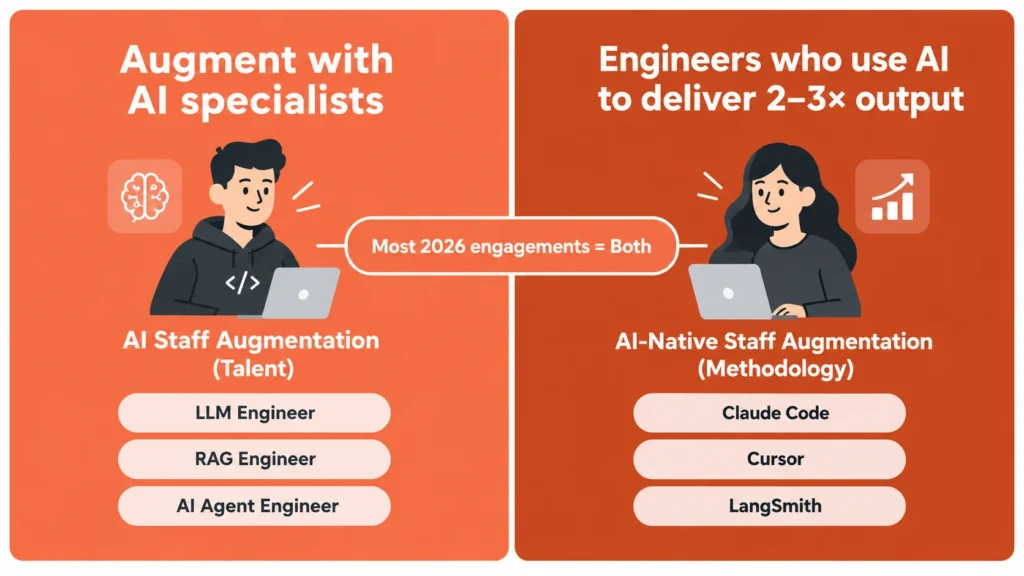
The Two Things “AI Staff Augmentation” Means
The term appears in vendor descriptions and buying guides to mean two very different things. Understanding which you need is the first decision.
Meaning 1: Augmenting your team with AI specialists
You have a product roadmap that requires AI engineering capability your current team does not have — LLM integration, RAG pipeline design, AI agent development, ML infrastructure, fine-tuning, vector database architecture. You add engineers who specialise in those disciplines, working under your technical direction, in your sprint process, on your codebase.
This is AI staff augmentation in the talent access sense. The model is traditional staff augmentation (engineer joins your team, reports to your leads, follows your process); the discipline is AI/ML engineering.
Meaning 2: AI-native staff augmentation
You need software engineering capacity — not necessarily AI-specific — but you want engineers who use AI development tools as standard workflow, producing materially higher output than a traditional hire at the same cost. An AI-native engineer using Claude Code, Cursor, and AI-assisted testing delivers 2–3× the output of a traditional engineer on scoped, well-defined tasks (HatchWorks 2026).
This is AI staff augmentation in the methodology multiplier sense. The discipline may be standard backend, frontend, or full-stack engineering; the difference is how the engineer works.
Most buyers in 2026 need both: AI-specific engineers who are also AI-native in their development workflow.
Why the AI Engineering Talent Gap Is Real in 2026
The gap between AI engineering demand and supply has grown every year since 2022 and is not closing.
The demand side: Every product roadmap in 2026 includes AI features. 85% of developers globally use AI tools regularly (JetBrains 24,534-respondent survey 2025). 65% of recruiters already use AI-powered hiring tools (Recruit AI Suite 2026). The number of companies attempting to build AI products has grown enormously.
The supply side: The number of engineers with genuine production AI experience (not prototype-level, not AI-curious — actual shipped RAG pipelines, production LLM integrations, multi-agent systems) has grown far more slowly. Senior AI engineers in the US receive multiple competing offers before accepting any.
The result:
- Full-time AI engineering hiring timelines: 3–6 months end-to-end
- 53% of U.S. technology leaders confident they can source AI talent — but 50% say staffing a cross-functional AI team takes 3+ months (X-Team 2026)
- AI staff augmentation fills this gap by placing vetted AI engineers in your team in 2 weeks or less
The AI-Native Multiplier: What Changes in 2026
Traditional staff augmentation has a clear value proposition: access a skilled engineer on demand without a permanent hire. That proposition has not changed.
What has changed is what an AI-native engineer delivers compared to a traditional hire at the same cost.
Traditional staff augmentation delivers:
- The engineer’s skills (programming languages, frameworks, domain expertise)
- The engineer’s hours (capacity in your team)
- Standard delivery practices (what the engineer already does)
AI-native staff augmentation delivers:
- The same skills and hours
- 2–3× output multiplier from AI-assisted development methodology (code generation, test generation, documentation, code review augmentation)
- Methodology transfer — the AI-native engineer’s working patterns (Context Pack discipline, Plan/Confirm habits, AI-assisted code review) embed in your team and persist after the contract ends
The methodology transfer is what most 2024-era staff augmentation conversations miss. In project outsourcing, the methodology stays inside the vendor’s team and never crosses the firewall into yours. In staff augmentation, the engineer sits inside your team, attends your standups, contributes to your repo, and reviews your code. The methodology transfers.
“A traditional staff augmentation engagement rents you an engineer. An AI-native engagement rents you the methodology that comes with them — and the methodology stays after the engineer leaves.” — HatchWorks 2026 Staff Augmentation Guide
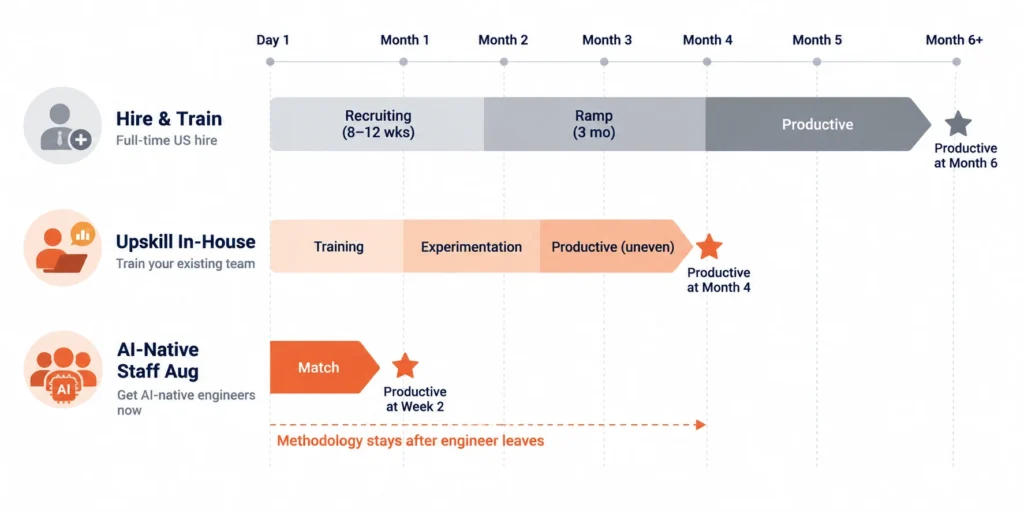
Timeline to productive output — three paths compared:
| Path | Time to productive output | Methodology transfer | Cost shape |
|---|---|---|---|
| Hire and train (full-time) | ~6 months (8–12 wks recruiting + ramp) | Yes, gradually | Permanent headcount + $24K recruitment + ramp cost |
| Upskill in-house team | ~4 months (uneven) | Yes, but uneven by engineer | Training cost + productivity drag during transition |
| AI-native staff augmentation | ~2 weeks | Yes — methodology stays after engagement ends | Pay only during engagement; no recruitment cost |
What AI Engineers You Can Augment With
Not all AI engineering roles are the same. The type of specialist you need depends on where your AI initiative is in its lifecycle.
| AI engineering role | Primary skills | When you need them |
|---|---|---|
| LLM Integration Engineer | OpenAI/Anthropic API, prompt engineering, function calling, streaming | Adding AI features to existing products; chatbots, copilots |
| RAG Engineer | Chunking strategy, vector databases, hybrid retrieval, reranking, evaluation | Building knowledge-grounded AI systems; document Q&A, enterprise search |
| AI Agent Engineer | LangGraph, LangChain, multi-agent orchestration, tool design, HITL | Building autonomous workflow agents; multi-step process automation |
| ML Engineer | Python/PyTorch, model training/fine-tuning, MLOps, data pipelines | Custom model development; fine-tuning, classification, recommendation |
| AI Infrastructure Engineer | GPU infrastructure, vector DB management, model serving, latency optimisation | Production AI at scale; serving latency, GPU cost management |
| AI Full-Stack Engineer | All of the above + frontend integration | Shipping complete AI products quickly; startups, fast-moving teams |
The most in-demand specialisation in 2026: RAG + LLM Integration Engineers — the skills required to build grounded, production-grade AI applications without building custom models. This combination is the bottleneck for most enterprise AI roadmaps.
The True Cost Comparison
The most common mistake: comparing the AI staff augmentation hourly rate against a salary. The correct comparison is total cost of engagement versus total cost of a full-time hire across the same period.
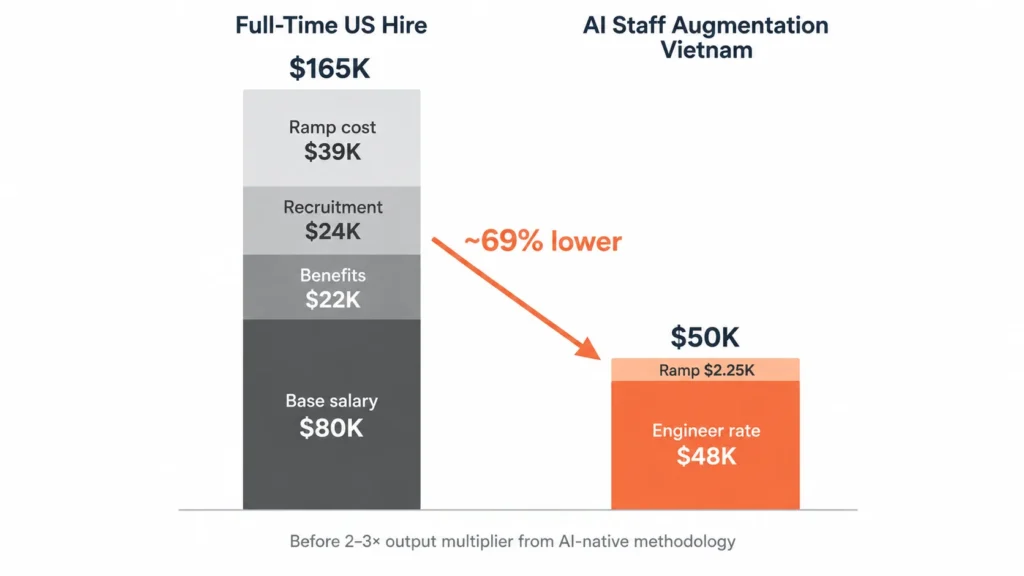
6-month cost comparison (senior AI engineer, US market rates):
| Cost component | Full-time US hire | AI staff augmentation (Vietnam, senior) |
|---|---|---|
| Base salary / engineer rate | $80,000 | $48,000 (~$50/hr × 160 hrs × 6 mo) |
| Benefits and overhead | $22,000 | $0 |
| Recruitment cost | $24,000 | $0 |
| Ramp cost (lost productivity) | $39,000 (~3 months) | $2,250 (~2 weeks) |
| Total 6-month cost | $165,000 | $50,250 |
| Effective cost difference | — | ~69% lower |
Figures illustrative for a senior AI engineer. US full-time rates from HatchWorks 2026; Vietnam augmentation rates from InApps. Ramp cost assumes 3 months at 50% productivity for in-house hire, 2 weeks at 50% for augmented engineer.
The multiplier compounds the saving. If an AI-native augmented engineer delivers 2–3× the output of a traditional hire at the same hourly rate, the effective cost per unit of shipped work is lower still. The 69% cost saving on the engagement cost underestimates the real productivity advantage.
Vietnam-specific rates (InApps, 2026):
| Role | Hourly rate range | Monthly cost (160 hrs) |
|---|---|---|
| LLM Integration Engineer | $40–$65/hr | $6,400–$10,400 |
| RAG Engineer | $45–$70/hr | $7,200–$11,200 |
| AI Agent Engineer | $50–$80/hr | $8,000–$12,800 |
| Senior ML Engineer | $55–$85/hr | $8,800–$13,600 |
| AI Full-Stack Engineer | $45–$75/hr | $7,200–$12,000 |
These rates represent senior-level engineers (5+ years experience, production AI deployments, AI-native workflow) — not junior engineers with AI coursework certificates.
How AI Staff Augmentation Actually Works
The mechanics are identical to standard IT staff augmentation — with the addition of an AI specialisation vetting layer.
Step 1: Role definition and match (Days 1–3)
You define: the AI engineering skills required, the systems the engineer will integrate with, the team structure they will join, the expected output in the first sprint.
The augmentation partner shortlists 2–3 vetted candidates. Vetting includes: AI-specific technical assessment (not just a coding challenge — a production scenario that tests RAG system design, tool call architecture, or agent loop debugging), previous production AI project review, and AI tooling proficiency demonstration.
Step 2: Technical interview and selection (Days 3–5)
You interview the shortlisted candidates. For AI roles specifically: ask the candidate to walk through a production AI system they built. What were the retrieval quality metrics? What broke in production? How did they instrument it? Candidates who cannot answer with specifics have prototype experience, not production experience.
Step 3: Onboarding and integration (Week 1–2)
The augmented engineer joins your team. For AI roles: access to your vector database, LLM API keys (within access policy), existing codebase context, and any data sources the AI systems will use. An AI-native engineer is typically productive by the end of week one.
Step 4: Active engagement under your direction
The engineer works in your sprint process, attends your standups, submits PRs to your repo, and follows your code review process. Your technical lead directs the work. The augmentation partner manages employment logistics and provides an engagement manager for escalation.
Key difference from project outsourcing: You direct the work. The engineer is integrated into your team. There is no black-box delivery — you see every commit.
Step 5: Methodology transfer (Ongoing)
For AI-native engagements specifically: the engineer’s AI tooling practices become visible to your in-house team. Context Pack discipline (structured context handed to AI coding tools), Plan/Confirm habits (agree on approach before implementation), AI-assisted code review — these patterns embed in your team’s workflow and persist after the contract ends.
What to Vet When Evaluating AI Augmentation Partners
The AI engineering talent market in 2026 has produced a significant number of providers claiming AI specialisation without the depth to back it. The vetting questions that separate real from nominal AI capability:
| Question | What a strong answer looks like | Red flag |
|---|---|---|
| “How do you vet AI engineering candidates?” | Technical scenario assessment testing production-specific skills (retrieval quality, agent loop debugging, observability setup) | “We test coding fundamentals and verify AI certifications” |
| “What AI tools do your engineers use daily?” | Named tools with specific workflows: Claude Code for code gen, Cursor for in-context editing, LangSmith for agent observability, Langfuse for RAG traces | “Our engineers use AI tools in their workflow” (no specifics) |
| “Can I see a production AI project the candidate shipped?” | Specific system with specific metrics: retrieval P99 latency, groundedness score, token cost per query, incident that broke it | “We have engineers with experience in AI projects” |
| “What is your replacement guarantee?” | 2-week replacement with same seniority and specialisation if the first match doesn’t fit | No replacement guarantee; “we’ll do our best” |
| “How do you handle IP and code ownership?” | Explicit clause: all code written during engagement belongs to the client | Ambiguous IP language |
| “Do you have ISO 27001 or SOC 2 certification?” | Yes, independently audited | “We follow security best practices” (no third-party certification) |
When AI Staff Augmentation Is the Right Model
AI staff augmentation fits when:
- You have internal technical leadership (CTO, engineering leads) who can direct AI engineering work — the augmented engineer reports to you, not the other way around
- You need specific AI skills for a defined period: a RAG pipeline for a product launch, an AI agent for a workflow, an LLM integration for an existing product
- Your internal team’s AI capability needs to grow — AI-native staff augmentation transfers methodology as a secondary benefit
- Speed matters: you need AI engineering capacity in 2 weeks, not 6 months
- You want to validate the business case for a permanent AI hire before committing headcount budget
AI staff augmentation does not fit when:
- You have no internal technical direction and need a team to own the AI product end-to-end (consider AI Agent Development or a dedicated AI team)
- The requirement is fully scoped and self-contained with a fixed deliverable (consider a project engagement)
- The AI engineering need is genuinely permanent and strategic — in that case, hire in-house (AI staff augmentation is a bridge, not a permanent substitute)
InApps AI Staff Augmentation
InApps places AI-native engineers under the IT Staff Augmentation service — with AI specialisation screening built into the vetting process, not bolted on as a label.
What makes InApps AI staff augmentation different:
1. Production AI vetting, not certification check. InApps technical assessment for AI roles goes beyond coding exercises. Candidates demonstrate a production RAG or agent system they built: what the retrieval architecture was, what broke in production, how they monitored it, what the quality metrics were. Engineers who cannot answer with specifics do not pass InApps’s 3% acceptance rate.
2. AI-native by default, not by press release. InApps engineers use AI development tools across their workflow — Claude Code, Cursor, LangSmith, Langfuse, AI-assisted test generation — as standard practice, not as a marketed feature. This is where the 30–55% build timeline compression (Retool/McKinsey 2026) is captured in practice.
3. Vietnam senior engineers at UK/AU-competitive quality. Vietnam (UTC+7) provides 4–5 hours of overlap with Australia AEST and async-compatible workflow with US/UK teams. Senior AI engineers at Vietnam rates (40–60% of US/UK equivalents) with ISO 27001:2022 certified security controls and full IP ownership by the client.
4. 30-day satisfaction guarantee. If the placed engineer is not the right match within 30 days, InApps replaces at no additional placement cost. No-risk trial with real production expectations.
InApps has placed AI engineers with financial services clients (Techcombank, Prudential), enterprise retail (KFC, Lotte, MM Mega Market), and SaaS companies across 15+ countries — all under ISO 27001:2022 certified security controls, 4.9/5 Clutch rating.
“We needed an engineer who understood RAG systems at a production level, not someone who had completed a course. InApps’s vetting process filtered that distinction before the interview. The engineer we placed was productive by day four — he identified a chunking issue in our existing pipeline that we had been fighting for three weeks.” — CTO, enterprise SaaS company (InApps AI client)
Request AI engineer profiles → — InApps presents vetted profiles within 3–5 business days of a role brief.
Frequently Asked Questions
What is AI staff augmentation?
AI staff augmentation means one of two related things in 2026: (1) augmenting your engineering team with AI specialists — LLM integration engineers, RAG engineers, AI agent developers, ML engineers — who work under your direction via the staff augmentation model; or (2) AI-native staff augmentation — engineers who use AI development tools as standard workflow, delivering 2–3× the output of a traditional hire at comparable cost. Most strong augmentation engagements in 2026 provide both: AI-specialist skills plus AI-native methodology.
How much does AI staff augmentation cost?
AI staff augmentation rates vary by specialisation and seniority. Vietnam-based senior AI engineers (LLM integration, RAG, AI agents) through a managed firm with proper vetting typically range from $45–$85/hour, or $7,200–$13,600/month. A 6-month senior AI engineer engagement costs $50K–$80K fully loaded — compared to $165K+ for a full-time US hire across the same period including recruitment, benefits, and ramp cost. The effective cost saving is 50–70%, before accounting for the 2–3× output multiplier from AI-native methodology.
How long does it take to place an AI engineer via staff augmentation?
Vetted AI engineers can be placed in 2–3 weeks from receipt of a role brief — compared to 3–6 months for a full-time hire in 2026’s AI engineering talent market. The timeline includes: 2–3 days for shortlisting, 2–5 days for technical interviews and selection, 3–7 days for onboarding access setup. Most InApps AI engineering placements are productive by the end of week one.
What AI engineering skills are most in demand for staff augmentation?
The three most in-demand specialisations in 2026: RAG engineers (chunking, vector databases, hybrid retrieval, reranking, evaluation — the skill stack for grounded AI applications), LLM integration engineers (API integration, function calling, prompt engineering, streaming, agent scaffolding), and AI agent engineers (LangGraph, multi-agent orchestration, tool design, HITL, observability). These three specialisations represent the skills needed to build production AI applications without developing custom foundation models.
What is the AI-native multiplier in staff augmentation?
An AI-native engineer uses AI coding tools (Claude Code, Cursor, AI-assisted test generation) as standard workflow, producing 2–3× the output of a traditional engineer on scoped tasks (HatchWorks 2026). More importantly, the methodology transfers: AI-native engineers working inside your team (not in an external outsourcing team) embed their tooling practices into your team’s workflow. The engineer leaves when the contract ends; the methodology stays. This is the key advantage of staff augmentation over project outsourcing for AI capability building.
How do I evaluate AI engineering candidates from a staff augmentation partner?
Ask every candidate to walk through a production AI system they built — not a demo, not a course project. Specific questions: What was the retrieval architecture and why? What was the retrieval quality metric at launch and how did you measure it? What broke in production, and how did you diagnose it? What observability tools did you set up? Candidates with genuine production experience answer with specifics. Candidates with prototype experience generalise. The distinction matters enormously in production — a RAG system that works in a demo and fails in production is one of the most common and expensive AI engineering mistakes.
Key Takeaways
- “AI staff augmentation” means two things: augmenting with AI specialists (talent access) and AI-native engineers delivering 2–3× output (methodology multiplier). Both apply in 2026.
- Full-time AI engineering hiring takes 3–6 months. AI staff augmentation places engineers in 2 weeks.
- 53% of US tech leaders confident they can source AI talent; 50% say it takes 3+ months to staff a single AI team (X-Team 2026).
- 6-month cost: Full-time US hire ~$165K vs AI staff augmentation (Vietnam senior) ~$50K — ~69% lower.
- The methodology multiplier: AI-native engineers deliver 2–3× output and transfer their working methodology to your team’s habits after the contract ends.
- Most in-demand roles: RAG engineers, LLM integration engineers, AI agent engineers.
- Vetting rule: Ask candidates to walk through a production AI system with specific metrics — retrieval quality, what broke, how they monitored it. Generalised answers indicate prototype experience.
- AI staff augmentation fits when: you have internal technical direction, need specific AI skills for a defined period, and want to grow team capability via methodology transfer.
- Does not fit when: you need end-to-end AI product ownership with no internal direction (use a dedicated AI team or managed development).
Work with us
Need a team that can do this on your codebase?
Tell us what you are shipping and we will send back a scope, a team shape and a fee. No obligation.
Book a free call