

On this page
TL;DR: Most failed staff augmentation engagements trace back to rushed vendor selection — not to bad engineers. The difference between a strategic partner and a transactional vendor shows up before you sign, not after. Ten questions separate them. Ask every provider the same questions. Insist on specific answers, not marketing language. The one that cannot answer question 1 with a number has already told you what you need to know.
Why Choosing the Wrong Partner Costs More Than the Fee
The global IT staff augmentation market exceeded $434 billion in 2026 (Digioxide, 2026). At that scale, every procurement category imaginable has entered the space — marketplaces, staffing agencies, offshore software houses, and boutique technical firms — all using the same terminology, all calling their talent “pre-vetted,” all quoting rates without disclosing what those rates include.
Choosing wrong is expensive in ways that do not appear on the invoice. A poorly vetted engineer burns 4–6 weeks of your senior team’s time before you acknowledge the fit is wrong. A provider with no replacement guarantee leaves you carrying the vacancy cost during a 6-week search. A long-term lock-in means you cannot exit a broken engagement without a penalty. A provider who disappears after placement turns your account manager role into your own problem.
“Most CTOs don’t regret hiring the wrong engineer. They regret hiring the wrong vendor — the one that sent them a CV flood, placed someone who left in four months, and disappeared when things went sideways.” — Kwan Engineering, Guide to Vetting IT Staff Augmentation Partners, 2026
The right evaluation framework treats the vendor selection call as a technical interview, not a sales demo. These ten questions run that interview.
Step 1: Ask for the Vetting Pass Rate — and Insist on a Number
The question: “What percentage of applicants actually pass your full vetting process?”
This single number reveals more about a provider than any marketing claim. Credible providers accept fewer than 10% of applicants after multi-stage technical screening. If a vendor responds with vague language about their “rigorous process” without giving a specific figure, that is the answer.
What a rigorous vetting process looks like in practice:
- Stage 1: Live coding assessment calibrated to seniority level — real-world problems, not algorithmic puzzles
- Stage 2: System design and architecture interview conducted by an internal engineer, not a recruiter
- Stage 3: English communication and written fluency evaluation (B2 minimum for effective async collaboration)
- Stage 4: Final panel review, references, and background checks
At InApps, 3% of applicants pass all four stages. That number is auditable — ask any provider you evaluate to show you the same.
What to watch for: A pass rate above 30% means the “vetting” is CV screening, not genuine technical assessment. A provider who cannot name the number of stages or who describes vetting as “our team reviews CVs carefully” has no real process.
Step 2: Confirm You Interview and Select — Before Any Offer Is Made
The question: “Do I interview the specific engineers before you make them an offer, or do I see profiles after they have already been engaged?”
You are adding engineers to your team. You set the technical direction, run the code reviews, and manage daily work. The people doing that work should be people you have met and approved — not a package assembled by the provider without your input.
The correct answer: you receive two to three matched profiles, you run your own technical interview, and the offer is contingent on your approval. A no from you triggers a new search at no cost.
Any provider who presents pre-packaged teams without offering direct interview access is either selling bench inventory or running a managed service model misrepresented as augmentation. Both are legitimate offerings; neither is what you asked for.
What to watch for: “You’ll meet the team on day one” is a red flag. “You interview and select before we make an offer” is the standard.
Step 3: Ask for the Replacement SLA — in Writing
The question: “If a placed engineer is not the right fit in the first 30 days, what is your replacement process, and how long does it take?”
The risk you are taking on when placing an augmented engineer is the probability that the first placement is wrong. Strong providers absorb that risk. Weak providers leave it with you.
A strong replacement guarantee has three components:
- No-cost replacement — the new search is at the provider’s expense
- Speed — replacement sourced and placed within 5–7 business days (not weeks), because the replacement comes from a pre-vetted pool, not a new search from scratch
- Coverage window — at minimum 30 days; some providers extend to 60 or 90
At InApps, the 30-day replacement guarantee operates as follows: you flag the issue, no notice period applies, replacement is sourced from the existing vetted pool in 5–7 business days, and your sprint timeline does not move.
What to watch for: “We’ll do our best to find a replacement” with no SLA is not a guarantee. “Replacement takes 4–6 weeks” means the provider is sourcing from scratch — they did not maintain a pre-vetted bench.
Step 4: Verify the Exit Terms Before You Negotiate Anything Else
The question: “What are the exit terms after the initial engagement period? Is there a minimum commitment, and what is the penalty for early exit?”
Your roadmap will change. Your priorities will shift. A market event will compress timelines, or an acquisition will change headcount plans. The engagement model you sign today needs to accommodate that reality.
Month-to-month billing with two weeks’ notice to scale in either direction is the standard strong providers offer. Anything that requires 90-day notice, a 6-month minimum term, or a penalty clause for early exit transfers risk to you — the buyer — without a corresponding benefit.
The practical test: if you are three months into a six-month minimum engagement and the engineer is wrong, you pay for the remaining three months regardless. That is not a partnership arrangement. It is a lock-in dressed as a contract.
At InApps: two weeks’ notice to scale up or down, no minimum term beyond the initial agreed period, no bench charge between engagements.
What to watch for: Any contract clause requiring more than 30 days’ notice to reduce headcount. Any minimum-term penalty above one month’s fee.
Step 5: Confirm Whether Engineers Are Named and Dedicated
The question: “Are the engineers assigned to my account dedicated full-time to my project, or are they shared across multiple clients?”
“Staff augmentation” by definition means an individual joins your team. The engineer attends your standups, commits to your repository, and reports to your tech lead. If they are also billed to another client for 30–40% of their time, you are receiving 60–70% of what you are paying for — and the engineer is context-switching in ways that reduce their effectiveness in both engagements.
Ask directly: “Will the engineers on my account work exclusively for me, or will they carry other client commitments simultaneously?”
What to watch for: “Our engineers are available to your team” without explicitly confirming exclusivity. “Shared model” or “fractional engagement” language in the contract.
Step 6: Map the Time Zone Overlap — Not the Claimed Overlap
The question: “What is the guaranteed daily overlap between your engineers’ working hours and my team’s core hours?”
For offshore augmentation, time zone overlap is not a technicality — it is the primary driver of how much a communication delay costs you. A two-hour clarification that could resolve in a standup becomes a two-day delay when working hours do not overlap.
The minimum viable overlap for effective collaboration is four hours per day of live, synchronous working time. Some providers flex engineer hours to match your core hours; verify whether this is standard or requires a premium.
Vietnam (GMT+7) overlaps:
- Australia/APAC: full timezone — no shift required
- Europe: 2–3 hours early afternoon overlap
- US East Coast: 1–2 hours early morning (with shifted hours, 4+ hours is achievable)
What to watch for: Providers who quote “global coverage” without specifying which engineers work which hours. Engagements structured entirely async — valid for some work, not for sprint-based development where daily standups are the primary coordination mechanism.
Step 7: Ask Who Manages Performance After Day One
The question: “Who is my point of contact after placement, and how often do they check in on engineer performance?”
The providers who disappear after placement are the ones whose value ends at sourcing. A genuine partner maintains account management that monitors engagement quality, surfaces performance issues early, and handles the operational complexity (payroll, equipment, local compliance) without creating work for you.
What good post-placement account management looks like:
- A named account manager assigned to your engagement, not a shared support queue
- Performance check-ins with the engineer every four weeks — not annual reviews
- An escalation path for technical or communication issues that does not route through a sales team
- Transparent reporting on engineer productivity, not just hours logged
At InApps, account managers conduct performance check-ins every four weeks and handle all HR, payroll, and compliance. They sit outside your technical chain of command — managing team health without interfering with engineering decisions.
What to watch for: “You can reach us anytime” without naming a specific contact or cadence. No described process for handling performance issues mid-engagement.
Step 8: Verify IP Ownership — Before Signing, Not After
The question: “When does IP in the code written by your engineers transfer to us — on first commit, or on final payment?”
This question has a correct answer and no ambiguity. IP should transfer to you from the first line of code, not at contract end or final invoice. Any arrangement where the provider retains rights to work product — or where transfer is gated behind payment — creates a leverage position you do not want when ending an engagement.
Three specific things to verify in the contract:
- IP transfers on creation (not on final payment)
- The code lives in your repository throughout the engagement — not in the provider’s infrastructure
- No component is retained or reused across other client accounts
Under Vietnamese law (Article 39, Law on Intellectual Property), economic rights in work created on assignment belong to the employer — InApps — and are assigned to you under the engagement agreement. The chain is: engineer → InApps → you. That assignment happens at the start of the engagement, not the end.
What to watch for: “IP transfers at contract completion.” Any clause about the provider retaining “methodology” or “components” — generic language that can be interpreted broadly against your interests.
Step 9: Ask About Security Controls — Not Certifications
The question: “Walk me through the technical controls that protect our code and data — not the certification, the controls themselves.”
ISO 27001:2022 and SOC 2 are verifiable signals that a security management system exists. They do not describe what happens in practice. Ask for the controls:
- Device management: Company-managed devices with endpoint protection, or BYOD?
- Access control: Least-privilege provisioned by you in your systems, or provider-managed access?
- Network: VPN and segregated network for client code, or a shared office network?
- NDA and background checks: Signed before any codebase access, or on contract close?
- Data handling: Do engineers access production databases? What is the access provisioning process?
At InApps: ISO 27001:2022 certified, company-managed devices, VPN and SSO, NDA and background checks completed during vetting before any codebase access. Access is provisioned in your systems and revoked by you at engagement end.
What to watch for: “We are ISO certified” without describing what that means in daily operation. BYOD environments with no device management policy. No written NDA process before engineers receive repository access.
Step 10: Ask for a Retention Rate — for the Engineers on Their Accounts
The question: “What percentage of engineers placed with clients are still on the same account after 12 months?”
High engineer retention signals that the provider attracts good engineers, manages them well, and structures engagements in ways that are sustainable for the engineer — which means less involuntary churn and fewer knowledge-transfer events for you.
Industry average for staff augmentation: 60–70% engineer retention at 12 months. Providers above 85% are demonstrably doing something different in how they manage the employment relationship.
At InApps, 92% of engineers are still on the same client account after 12 months. That number comes from a combination of competitive compensation, a clear career path for placed engineers, and an engagement model that makes long-tenure good for everyone.
What to watch for: No retention data available — a provider who cannot tell you their retention rate either does not track it or does not want to share it. Either is a signal.
The Evaluation Scorecard: How to Compare Providers
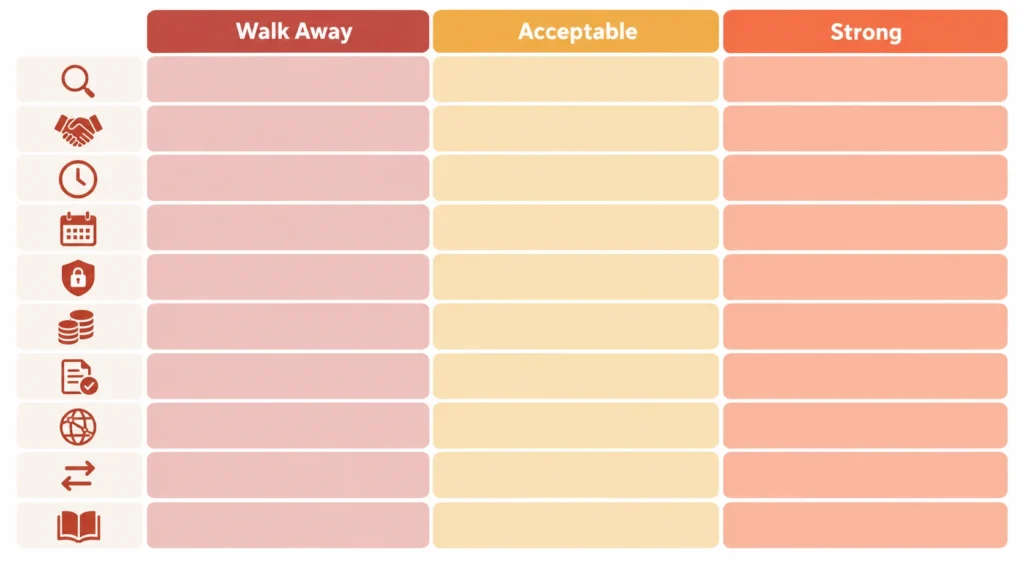
Use this scorecard across every provider you evaluate. Score each criterion 0 (unsatisfactory), 1 (partial), or 2 (strong). Total out of 20.
| Criterion | 0 — Walk Away | 1 — Acceptable | 2 — Strong |
|---|---|---|---|
| Vetting pass rate | Cannot name a number | >15% | <10% with named stages |
| Candidate interview | You see team on day one | Profiles, then interview | You interview, then offer |
| Replacement SLA | No guarantee | >2 weeks, vague | 30-day guarantee, 5–7 days |
| Exit terms | 6+ month minimum | 30–90 day notice | 2 weeks’ notice, no minimum |
| Engineer exclusivity | Shared across clients | Fractional, disclosed | Full-time dedicated only |
| Time zone overlap | Async only | 2–3 hours | 4+ hours guaranteed |
| Post-placement support | No named contact | Shared queue | Named account manager, 4-week check-ins |
| IP ownership | On final payment | On contract end | On first commit |
| Security controls | BYOD, no MDM | ISO certified, unspecified | Named controls, auditable |
| Engineer retention (12mo) | No data | 60–70% | 85%+ |
Score interpretation:
- 16–20: Strong partner — proceed to contract review
- 10–15: Acceptable with negotiated protections — push on weaker areas
- Below 10: Walk away — the gaps will surface during delivery
Red Flags That Should End a Conversation Early
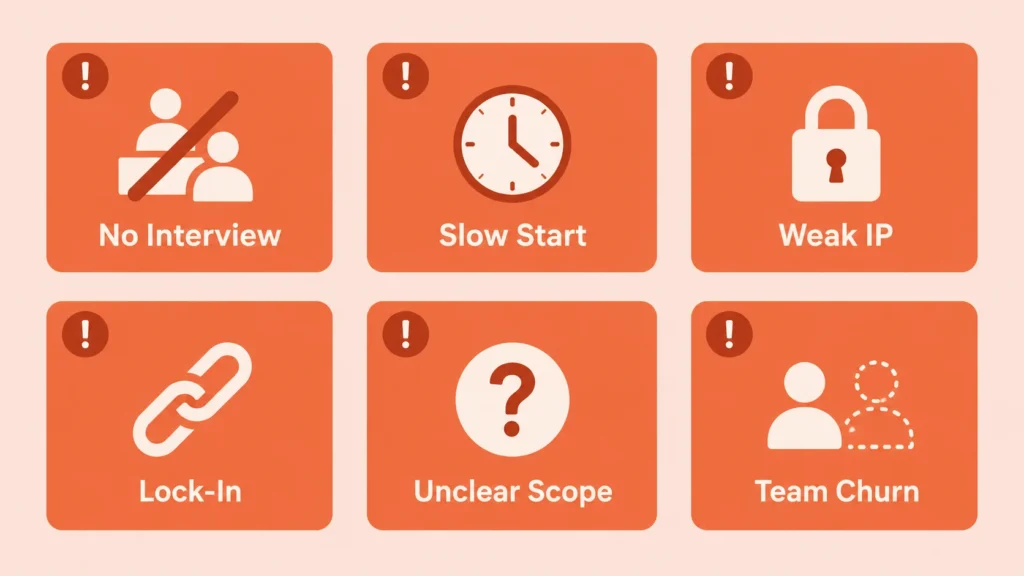
| Signal | What It Means |
|---|---|
| Refuses to let you interview engineers directly | Selling bench inventory, not staff augmentation |
| Cannot name a single client outcome or reference | No track record, or unwilling to stand behind it |
| Pressures urgency (“we have the perfect engineer ready today”) | Bench clearance, not a genuine match to your spec |
| No replacement policy in writing | Risk of vacancy cost lands entirely on you |
| Dodges questions about where engineers are based | May be subcontracting without disclosing it |
| “Proprietary methodology” IP language in contract | Components may be reused across accounts |
| No named account manager after day one | You are managing the engagement alone |
| Vetting described in marketing language with no process specifics | There is no process |
How InApps Answers Each Question
InApps was built to answer every question in this guide with a specific, verifiable response — because the questions themselves reflect the failure modes we see most often in competitive evaluations.
| Question | InApps Answer |
|---|---|
| Vetting pass rate | 3% of applicants pass all four stages |
| Can I interview engineers? | Yes — you interview before we make any offer. A no costs nothing. |
| Replacement SLA | 30-day guarantee, replacement in 5–7 business days at no cost |
| Exit terms | 2 weeks’ notice to scale either direction. No minimum term. |
| Engineer exclusivity | Full-time dedicated — never split across clients |
| Time zone overlap | Vietnam GMT+7 — full APAC, 2–3hr EU, shifted hours for US |
| Post-placement support | Named account manager, performance check-ins every 4 weeks |
| IP ownership | On first commit — assigned in the engagement agreement |
| Security controls | ISO 27001:2022, company-managed devices, VPN, NDA before codebase access |
| Engineer retention | 92% still on the same account at 12 months |
“On time. Every time. And when I had questions — any questions — they were answered in full. That’s not common.” — Margo Flanagan, Director, Two Raw Sisters (InApps client)
InApps holds 4.9/5 on Clutch from 50+ verified reviews, 85%+ multi-year client retention, and 94% client re-engagement across 200+ placements since 2016.
Ready to run this evaluation with InApps? Talk to a Solutions Consultant → — no pitch, no discovery invoice. We will answer every question above in writing before you sign.
Frequently Asked Questions
How do you evaluate a staff augmentation partner?
Evaluate on ten criteria: vetting pass rate (strong providers are under 10%), whether you interview engineers before any offer, replacement guarantee SLA and cost, exit terms and minimum commitment, engineer exclusivity, time zone overlap hours, post-placement account management, IP ownership timing, security controls, and 12-month engineer retention rate. Get every answer in writing. A provider who cannot give specific numbers on vetting and retention has told you what you need to know.
What questions should you ask a staff augmentation company?
Ten questions matter most: (1) What is your vetting pass rate? (2) Do I interview engineers before you make an offer? (3) What is your replacement guarantee and timeline? (4) What are the exit terms? (5) Are engineers dedicated exclusively to my account? (6) What is the guaranteed daily time zone overlap? (7) Who manages my account after day one? (8) When does IP transfer — on first commit or final payment? (9) What specific security controls protect my code? (10) What is your 12-month engineer retention rate?
What is a reasonable vetting pass rate for a staff augmentation provider?
Credible providers accept fewer than 10% of applicants after multi-stage technical screening. A pass rate above 30% indicates the vetting is CV review rather than genuine technical assessment. The pass rate is meaningful only when paired with a description of the stages — live coding, system design, communication assessment, and references are the minimum for a rigorous process.
How long should a staff augmentation replacement take?
5–7 business days for a provider with a pre-vetted bench. A replacement that takes 4–6 weeks means the provider is sourcing from scratch, not from an existing vetted pool. The difference matters: a 6-week vacancy on a sprint-based team is a significant delivery disruption. Ask any provider whether their replacement timeline comes from re-sourcing or from an active bench.
Should a staff augmentation engagement require a minimum term?
No. Month-to-month billing with two weeks’ notice to scale in either direction is the standard strong providers meet. Minimum terms of 3–6 months with penalty clauses shift all risk to the buyer without a corresponding benefit. If a provider requires a long minimum term before you have seen the quality of a single placement, that is a lock-in, not a partnership arrangement.
When does IP transfer in a staff augmentation engagement?
It should transfer on the first commit — not at contract end or on final payment. Code should live in your repository throughout the engagement, under your access controls. Any arrangement where IP is gated behind payment or where the provider retains rights to “methodology” or “components” creates a leverage position against you when the engagement ends. Get the IP clause in writing before signing.
Key Takeaways
- Most staff augmentation failures trace to rushed vendor selection, not the engineers themselves.
- The vetting pass rate is the single most predictive number — credible providers are under 10%; InApps is 3%.
- You must interview and approve engineers before any offer is made. A no should cost nothing.
- Replacement guarantees matter: 5–7 business days from a pre-vetted bench, not 4–6 weeks from a new search.
- Exit terms: two weeks’ notice is the standard. Any minimum-term lock-in shifts risk to you.
- IP transfers on first commit, not on final payment. Verify this in the contract before signing.
- Score every provider on all ten criteria before committing. A provider who deflects or speaks in generalities on any of them has already disqualified themselves.
Work with us
Need a team that can do this on your codebase?
Tell us what you are shipping and we will send back a scope, a team shape and a fee. No obligation.
Book a free call