
On this page
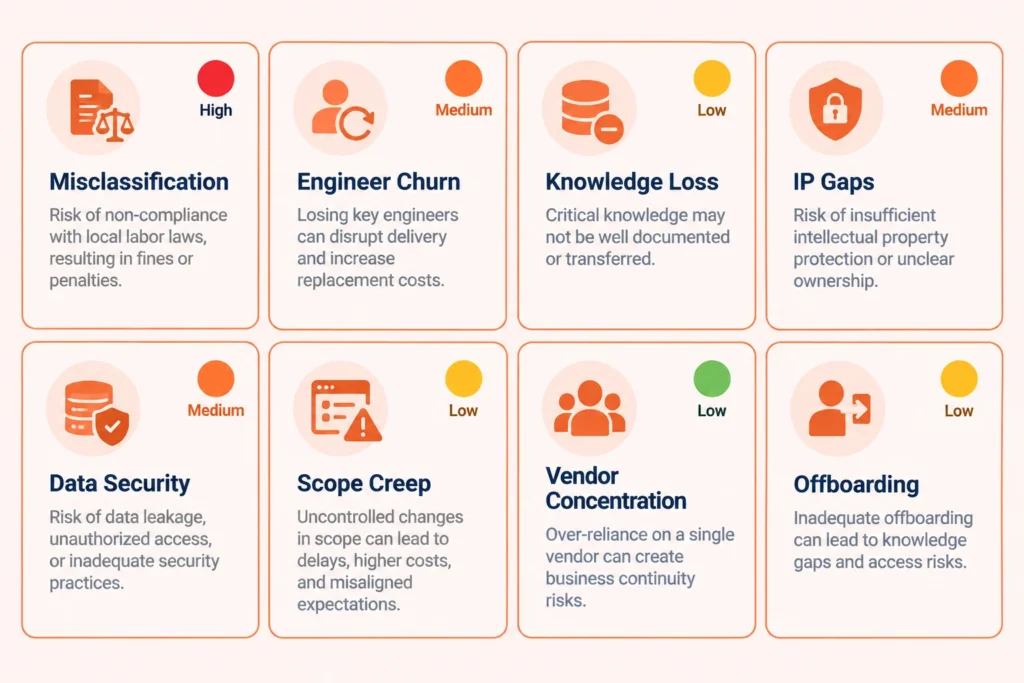
TL;DR: Staff augmentation carries eight real risks: worker misclassification (11.4% dispute rate without a proper employer of record), mid-engagement engineer churn (15–25% at low-quality providers vs under 5% at top providers), knowledge loss at contract end, IP ownership gaps, data security exposure, scope creep, vendor concentration, and weak internal management. Nearly every risk is addressable with the right contract terms and the right provider — before signing, not after. Misclassification has the largest downside because it appears in no rate comparison and can invert the entire cost case.
Why Acknowledging Risk Is Part of Making Augmentation Work
Staff augmentation delivers real benefits — speed, specialist access, cost flexibility — but only when the risks are managed deliberately. The failure modes are not random. They trace back to the same root causes: poor provider vetting, weak contract terms, insufficient internal management capacity, and documentation treated as optional.
This article names each risk, the evidence behind it, and the specific control that addresses it. The goal is not to discourage augmentation — 78% of businesses plan to expand their use in 2026 (Digioxide, 2026) — but to help you implement it correctly.
“Almost every control is a contract term, which makes them cheap now and expensive to retrofit.” — Second Talent IT Staffing Intelligence, May 2026
Risk 1: Worker Misclassification — The Highest-Downside Risk
The risk: Misclassification occurs when the actual working relationship resembles an employment relationship but the engineer is contracted as an independent worker. Tax authorities can reclassify the worker retroactively, demanding unpaid employer taxes, benefits, and penalties. Unlike most augmentation risks, this one does not show up on a rate comparison until it appears as a liability.
The data: Forrester’s 2026 Contingent Workforce Compliance research found an 11.4% classification dispute rate for buyers using direct 1099 contractor relationships without provider intermediation — versus 0.3% for buyers using employer-of-record (EOR) providers who legally employ the engineers.
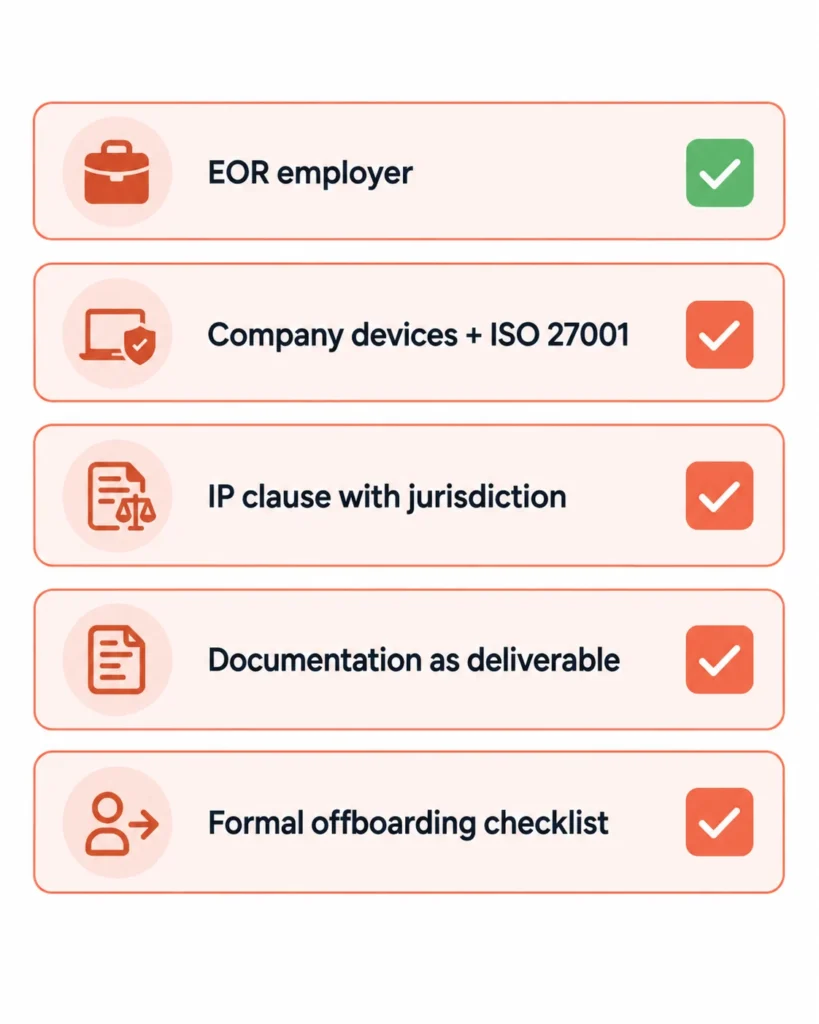
The control: Use only staff augmentation providers that operate as the legal employer through owned entities in the country where engineers are based. The employment chain must be explicit and auditable: engineer → provider (employer of record) → you. InApps employs all placed engineers in Vietnam under Vietnamese labour law, handles payroll, benefits, and compliance, and carries full employment responsibility. You are a client; you are not the employer.
What to verify: Ask the provider: “Are your engineers your employees or independent contractors?” If the answer is “independent contractors,” the misclassification risk sits with you. If the provider is an EOR with owned entities (not a subcontracting chain), the risk sits with them.
Risk 2: Mid-Engagement Engineer Churn
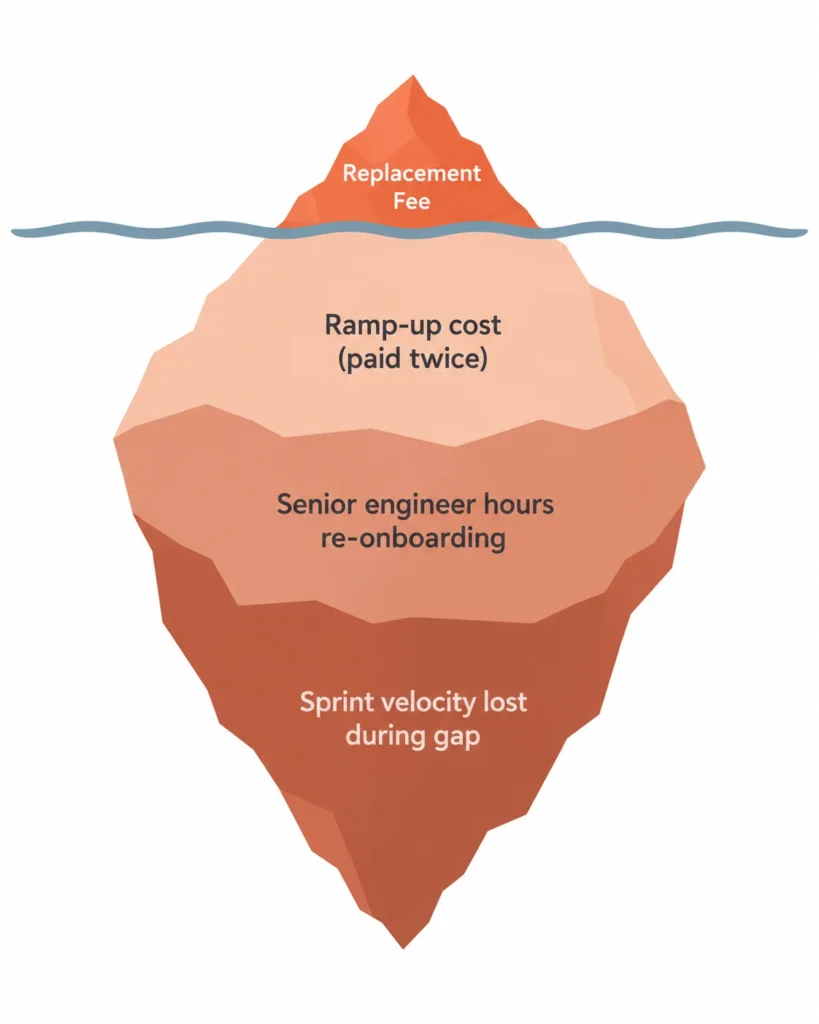
The risk: When an augmented engineer leaves mid-engagement, you absorb the ramp-up cost twice — once for the original engineer and once for the replacement. A typical onboarding to full sprint contribution runs two to four weeks on a documented codebase, longer on a legacy system. If the replacement arrives in six weeks, you lose two months of expected output.
The data: Forrester’s 2026 IT Staffing Performance Benchmark found quality providers report under 5% mid-engagement churn; legacy providers and freelancer platforms report 15–25%. The hidden cost of a replacement includes not just the provider’s placement work but the senior engineer hours spent re-onboarding — which Cloud Employee’s 2026 analysis estimates at more than 50% of the replacement’s annual salary in total lost productivity.
The control: Three levers, in priority order:
- Select for retention. Ask any provider for their 12-month retention rate on placed engineers — the quality answer is 85%+. At InApps, 92% of engineers are still on the same client account after 12 months. This is the most reliable upstream control.
- Negotiate a replacement guarantee with teeth. Verify three things: how many days to a replacement profile (should be 5–7 from a pre-vetted bench, not a new search), whether the trial period restarts for the new engineer, and who absorbs the cost of the ramp-up gap. At InApps, the 30-day guarantee covers replacement in 5–7 business days at no cost.
- Monitor early-warning signals. Second Talent’s 2026 analysis identifies the predictive signals: rework stopping falling after week four (the engineer has stopped trying to improve), blockers no longer being raised (disengagement), and account manager changes on the provider side (predicts engineer churn more often than not).
Risk 3: Knowledge Loss at Contract End
The risk: Augmented engineers accumulate deep knowledge of your architecture, deployment decisions, historical workarounds, and business logic. When the engagement ends, that knowledge leaves unless it was documented throughout. This makes future maintenance slower and more expensive — sometimes requiring a new engagement to rebuild the understanding the previous engineer held in their head.
The data: Coders.dev’s 2026 Enterprise Contract analysis identifies this as the most common form of “tacit vendor lock-in” — the code is legally yours, but the tacit knowledge to maintain or evolve it departed with the engineer. The cost is not a contract dispute; it is a compounding drag on every future sprint.
The control: Documentation must be a deliverable, not a task. Three structural controls:
- Make documentation part of the definition of done from sprint 1 — not a handover sprint at the end. Require architecture decision records, deployment runbooks, and notable implementation notes as part of every PR.
- Pair augmented engineers with internal leads throughout the engagement — not just at onboarding. This builds shared context that survives the engineer’s departure.
- Schedule a structured handover window in the contract — at least two weeks where the departing engineer overlaps with their replacement or your internal team.
At InApps, account managers conduct four-weekly performance check-ins and monitor documentation discipline as part of engagement health. Documentation standards are set with the client at the start of the engagement.
Risk 4: IP Ownership Gaps
The risk: “The client owns all code” is standard contract language. It is not always sufficient. IP first-ownership rules differ by jurisdiction under the Berne Convention framework — a clause drafted only to your governing law may not transfer what you expect when the engineer is in a different country. Additionally, some providers retain rights to “methodology” or “components” through vague language that can be interpreted against you during a funding round or acquisition.
The data: Coders.dev (2026) identifies IP transfer failure as “the most common point of failure in staff augmentation” — specifically: the client owns the code but lacks the tacit knowledge to use it (knowledge lock-in), or the contract’s IP clause does not hold under the engineer’s local jurisdiction.
The control: Three explicit checks in the contract:
- IP transfers on creation — not on final payment, not at contract end.
- Name the IP assignment law inside the IP clause — not just in the general governing law provision. Second Talent (2026) specifically flags this: jurisdictional specificity in the IP clause, not general terms.
- Prohibit undisclosed subcontracting — if the provider subcontracts to another entity, that entity’s employment relationship determines IP first-ownership. Require disclosure of the full chain.
Under Vietnamese law (Article 39, Law on Intellectual Property), economic rights in work created on assignment belong to InApps as employer, and are assigned to you under the engagement agreement from the first commit. The assignment is law-specific, not assumed.
Risk 5: Data Security and Third-Party Exposure
The risk: Augmented engineers access your source code, repositories, cloud environments, customer data, and internal documentation. Each access point is a potential exposure. When engineers work remotely on personal devices without managed controls, the attack surface is real.
The data: Verizon’s 2026 Data Breach Investigations Report found third-party involvement in 48% of breaches in its dataset — a 60% increase from the previous year. Tekinvent’s 2026 IT Staff Augmentation Risk analysis notes this does not mean 48% of augmentation engagements experience a breach — but it shows why vendor access controls require serious attention. A separate risk: augmented engineers using unsanctioned generative AI tools may inadvertently feed proprietary code into public model training pipelines.
The control: Five controls, each non-negotiable:
- Least-privilege access — provision each engineer only for the systems their specific role requires. A frontend developer does not need production database access.
- Individual accounts with MFA — no shared credentials; individual accounts enable accountability and clean offboarding.
- Company-managed devices — not BYOD. Each engineer should work from a provider-managed device with endpoint protection.
- NDA and background checks before codebase access — signed and verified before any repository access is granted.
- AI usage policy — define which AI coding tools are permitted and prohibit uploading proprietary code to unapproved external models.
At InApps: ISO 27001:2022 certified, company-managed devices, VPN and SSO, NDA signed during the vetting process before any client access. Background checks are completed in stage four of the vetting process. Engineers work from InApps-managed offices in Ho Chi Minh City, not from personal home networks.
Risk 6: Scope Creep and Management Overhead
The risk: Staff augmentation requires your engineering manager to direct the work. When the scope expands informally — additional features added verbally, architecture decisions made outside the sprint board, work appearing that was not in the original brief — two problems compound: the budget grows without a change order, and the classification picture quietly shifts toward employment territory.
The data: Cloud Employee’s 2026 failure analysis found that scope creep is the second most common cause of cost overruns in augmentation engagements after poor vetting. Second Talent (2026) notes that scope creep “expands the work without expanding the budget, and it quietly changes the classification picture at the same time.”
The control: Two structural controls:
- Written work order with a change process — any scope addition requires a written change order with a rate implication agreed before work starts.
- Track scope signals in standups — work appearing in standups that is not on the sprint board is the earliest visible signal of scope creep. Engineering managers should flag it immediately, not at the sprint review.
The management overhead risk is separate: Stratagem Systems’ 2026 analysis found augmentation requires 15–25% of a manager’s time per engineer. For four engineers, that is the equivalent of one full-time manager. If that capacity does not exist, the engagement creates overhead rather than velocity — regardless of how good the engineers are.
Risk 7: Vendor Concentration
The risk: Running all augmentation engagements through a single provider creates concentration risk. A provider data breach, financial difficulty, legal dispute, or operational failure affects all your engagements simultaneously. For enterprises running 50+ augmentation seats, Gartner’s 2026 IT Sourcing Risk framework flags vendor concentration as a top-5 sourcing risk.
The data: Most organisations with fewer than five augmented engineers are not at meaningful concentration risk. The threshold at which concentration risk becomes significant is typically 10+ engineers from one provider, or when one provider controls access to a critical system without documented handover procedures.
The control: Second Talent (2026) recommends splitting when “enough seats depend on a single provider that a single failure would hurt” — typically at 15+ engineers or when a regulator requires demonstrated concentration management. For most growth-stage companies, the concentration risk is secondary to vetting quality and contract terms. The primary mitigation is ensuring client-owned systems and documentation throughout — so that a provider transition is operationally feasible.
At InApps, all code, repositories, and documentation are in your infrastructure from day one. A transition away from InApps is structurally possible at any point — which is the only meaningful protection against concentration risk.
Risk 8: Incomplete Offboarding
The risk: When an engagement ends, access revocation must happen completely and immediately. Engineers who retain access to repositories, cloud systems, communication platforms, or VPNs after offboarding represent both a security risk and a compliance gap. For regulated industries (fintech under DORA, healthcare under HIPAA), incomplete offboarding can trigger audit findings.
The data: Tekinvent’s 2026 security checklist identifies incomplete offboarding as one of the twelve IT staff augmentation risks with direct compliance exposure. The most common failure is access that “should have been removed” but was not — email lingering active, repository access not fully revoked, VPN credentials not rotated.
The control: A formal offboarding checklist, executed at engagement end and verified:
- Revoke: repository access, cloud system credentials, communication platform seats, VPN access, project management tool access
- Rotate: any shared credentials or API keys the engineer had access to
- Collect: company equipment returned; any materials stored on personal devices deleted per NDA
- Transfer: handover of completed work, open tasks, unresolved defects, deployment instructions, and known risks
Schedule offboarding planning two to four weeks before the anticipated end date — not on the last day.
Risk Severity and Mitigation Summary
| Risk | Severity | Probability without controls | Primary mitigation |
|---|---|---|---|
| Worker misclassification | 🔴 Critical | 11.4% (Forrester 2026) | Use EOR provider only |
| Mid-engagement churn | 🟠 High | 15–25% at low-quality providers | Provider retention data + replacement SLA |
| Knowledge loss | 🟡 Medium-High | Very common; rarely tracked | Documentation as definition-of-done |
| IP ownership gaps | 🟠 High | Common in cross-jurisdiction engagements | Jurisdiction-specific IP clause |
| Data security exposure | 🟠 High | 48% third-party breach involvement (Verizon 2026) | ISO 27001, managed devices, least-privilege |
| Scope creep | 🟡 Medium | 2nd most common cost overrun cause | Written change orders from sprint 1 |
| Vendor concentration | 🟢 Low-Medium | Relevant at 10+ engineers | Client-owned systems throughout |
| Incomplete offboarding | 🟡 Medium | Common without formal process | Formal checklist, 2 weeks before end |
How InApps Structures Controls for Each Risk
| Risk | InApps control |
|---|---|
| Misclassification | InApps employs all engineers in Vietnam under Vietnamese law — full EOR. 0.3% dispute rate category. |
| Churn | 92% engineer retention at 12 months. 30-day replacement guarantee, 5–7 business days from vetted bench. |
| Knowledge loss | 4-week check-ins include documentation review. Standards set at engagement start as definition-of-done. |
| IP gaps | Assignment from first commit, law-specific in the agreement. No subcontracting without disclosure. |
| Data security | ISO 27001:2022, company-managed devices, VPN + SSO, NDA before codebase access, background checks stage 4. |
| Scope creep | Written engagement scope; account manager flags out-of-scope work in check-ins. |
| Concentration | All code in client infrastructure from day one. Transition is operationally feasible at any point. |
| Offboarding | Formal offboarding process; InApps account manager owns revocation checklist execution. |
“On time. Every time. And when I had questions — any questions — they were answered in full. That’s not common.” — Margo Flanagan, Director, Two Raw Sisters (InApps client)
750+ projects delivered. 85%+ multi-year client retention. 4.9/5 on Clutch from 50+ verified reviews.
Want to understand how each risk is handled before you sign? Book a discovery call → — we will walk through every control in writing, not on a call.
Frequently Asked Questions
What are the main risks of IT staff augmentation?
Eight risks matter: worker misclassification (11.4% dispute rate without an EOR provider per Forrester 2026), mid-engagement engineer churn (15–25% at low-quality providers), knowledge loss at contract end, IP ownership gaps across jurisdictions, data security exposure (third-party involvement in 48% of breaches per Verizon 2026 DBIR), scope creep and management overhead, vendor concentration, and incomplete offboarding. All are addressable with the right contract terms and provider selection.
What is the biggest risk in IT staff augmentation?
Misclassification carries the largest downside — it does not appear in rate comparisons but can result in back taxes, benefits, and penalties that invert the cost case entirely. Forrester’s 2026 research found an 11.4% dispute rate for buyers using direct 1099 contractor relationships, versus 0.3% for those using employer-of-record providers. Use only providers who are the legal employer through owned entities in the engineer’s country.
How do you prevent knowledge loss when an augmented engineer leaves?
Three controls: (1) make documentation part of the definition of done from sprint 1 — not a final-week task; (2) pair augmented engineers with internal leads throughout the engagement, not just at onboarding; (3) build a structured two-week handover window into the contract. Context that exists only in one person’s memory leaves with them. Context captured in architecture decision records, runbooks, and paired knowledge stays.
How does staff augmentation affect data security?
Augmented engineers access your source code, cloud environments, and potentially customer data — extending your security perimeter. Controls: least-privilege access for each role, individual MFA-protected accounts (no shared credentials), company-managed devices (not BYOD), NDA and background checks before any codebase access, and a formal AI usage policy that prohibits uploading proprietary code to unapproved external models. Verizon’s 2026 DBIR found third-party involvement in 48% of breaches — vendor access controls require the same rigour as internal access management.
Who owns the IP in a staff augmentation engagement?
You should — from the first commit. But “the client owns all code” contract language is not always sufficient across jurisdictions. Verify: IP transfers on creation (not final payment), the IP clause names the assignment law specifically (not just the general governing law), and subcontracting chains are disclosed and covered. In InApps engagements, IP is assigned under Vietnamese law (Article 39) in the engagement agreement — jurisdiction-specific, not assumed.
What happens if a staff augmentation engineer leaves mid-engagement?
Churn risk depends entirely on the provider. Quality providers (under 5% mid-engagement churn, per Forrester 2026) maintain pre-vetted benches that enable 5–7 business day replacement. Low-quality providers with 15–25% churn require new sourcing, which takes 4–6 weeks and means you absorb the ramp-up cost twice. Negotiate a replacement guarantee that specifies days to profile, whether the trial restarts, and who absorbs the ramp gap — before signing.
Key Takeaways
- 8 risks, all manageable: misclassification (highest downside), churn, knowledge loss, IP gaps, data security, scope creep, vendor concentration, offboarding.
- Misclassification has the largest financial downside — 11.4% dispute rate without an EOR provider (Forrester 2026). Use EOR providers only.
- Churn: quality providers report under 5% mid-engagement churn vs 15–25% at low-quality providers (Forrester 2026). Ask for 12-month retention data.
- Knowledge loss is structural, not accidental — it requires documentation as a definition-of-done criterion from sprint 1.
- Verizon 2026 DBIR: third-party involvement in 48% of breaches (60% increase YoY). ISO 27001 + managed devices + least-privilege access are the baseline.
- Almost every control is a contract term. Retrofit is expensive. Set controls at signature.
- The right provider eliminates most risks structurally — not through promises, but through auditable processes.
Work with us
Need a team that can do this on your codebase?
Tell us what you are shipping and we will send back a scope, a team shape and a fee. No obligation.
Book a free call