
On this page
TL;DR: Staff augmentation works for startups at Seed and Series A+ — not at Pre-seed, and not for every need even after funding. The model requires a technical lead who can direct the incoming engineers. Without one, managed outsourcing is a safer choice. With one, augmentation gives you 1–2 senior engineers in the sprint in one to two weeks, 40–60% below US onshore cost, on your tools and roadmap, with full IP ownership from the first commit. The stage determines what you need; the roadmap determines whether you need people or direction.
Why Stage Determines Whether Augmentation Is the Right Model
The most common startup mistake with staff augmentation is buying it at the wrong stage. A pre-seed company with no technical co-founder adds two augmented engineers and discovers nobody can direct them — the management overhead falls on the founder, and the engineers produce misaligned work at full price.
The model is not wrong. The timing is.
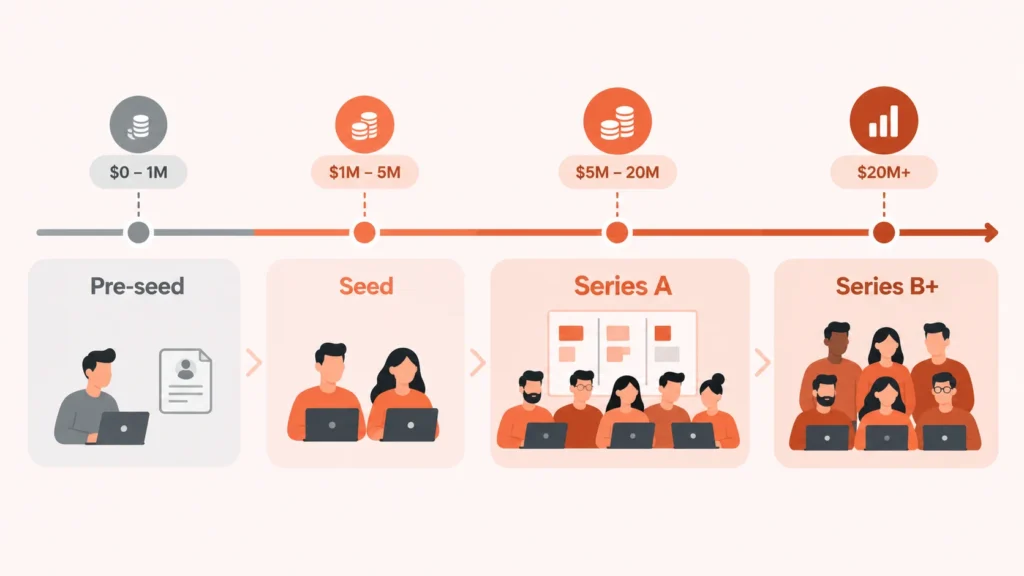
According to Kanerika’s 2026 Startup Engineering Guide, the correct stage-model mapping looks like this:
| Startup stage | Usual fit | Why |
|---|---|---|
| Pre-seed, no tech lead | Managed outsourcing or MVP agency | No internal capacity to direct daily engineering work |
| Seed, lean tech lead | Staff augmentation (1–2 specialists) | Tech lead can direct augmented engineers alongside the core team |
| Series A, funded roadmap | Augmentation for spikes + full-time for core | Fixed cost justified for long-term roles; augmentation fills specific gaps fast |
| Series B+, scaling | Augmentation + dedicated team | Parallel workstreams require both fast fill (augmentation) and standing squads (dedicated team) |
Early-stage companies now operate at a 27% hiring rate — down 35% from 49% two years ago, per Ravio’s 2026 Compensation Trends report. Median Series A headcount dropped 17.5% in five years. Startups are running leaner, which makes augmentation’s on-demand model structurally more relevant — and the stage-fit question more important to get right.
Pre-Seed: When Augmentation Is Usually the Wrong Answer
At pre-seed, the typical team is a founding pair or small group with limited capital and undefined architecture. The honest answer is that staff augmentation requires internal engineering leadership to work — and most pre-seed companies do not have it at the right availability level.
The problem: Augmented engineers take direction from your engineering lead. If that lead is the founding engineer who is also making product decisions, setting architecture, writing code, and onboarding the augmented engineer — you have not added capacity. You have created a second job for your most important person.
What works instead: Fixed-price MVP development with a firm scope. An external team owns delivery end-to-end, you review milestones and provide product feedback, and the founding engineer is not the full-time manager of people they did not hire. At InApps, MVP Development covers discovery, design, build, QA, and launch under a fixed scope — specifically designed for founders who need something built rather than engineers to direct.
The exception: If the founding team includes a CTO or principal engineer who is specifically available to direct external engineers (not shipping full-time), augmentation of one specialist for a bounded, defined task is viable. The test: can you write a clear brief, write a ticket for each piece of work, and run a 30-minute daily standup without it taking meaningful time away from your other responsibilities? If yes, augmentation works. If not, it does not.
Seed Stage: The First Real Use Case for Augmentation
At seed, the founding team typically has a technical co-founder or early CTO who has established architecture and is running a small core team. The roadmap is defined enough to have a backlog. The gaps are specific: a skill the team does not have, a second engineer for a release sprint, or a specialist for a time-bounded feature.
What augmentation solves at seed:
Missing specialist skills. A seed-stage fintech team needs a payment flow specialist for one quarter to launch a checkout integration. Hiring full-time for a role that may not be needed at the same intensity post-launch is economically wasteful. Augmentation closes the gap for the duration of the need.
Release sprints that outpace the core team. A launch date compresses the roadmap in ways the three-person team cannot absorb. Two additional engineers for six weeks get the release done without committing to permanent headcount against a capital base that needs to last.
Headcount budget flexibility. Seed capital has a burn rate attached. An augmented engineer converts a fixed employment cost to a variable spend — you pay for the months you need the capacity, and scale down when you do not. SHRM’s 2025 benchmarking data puts the average cost-per-hire for senior engineering roles above $10,000, not counting the 3–4 month time-to-productivity. Augmentation eliminates both.
What augmentation does not solve at seed:
Direction deficit. If you do not have a clear backlog, defined acceptance criteria, and a tech lead available to review PRs, augmented engineers produce work at a slower rate than the overhead they create. The quality of your brief determines the quality of the output.
Series A: The Optimal Stage for Staff Augmentation
Series A is where staff augmentation most consistently delivers its stated benefits — speed, specialist access, cost efficiency, and flexibility — because the conditions that make it work are typically in place.
At Series A, the median engineering team is 8–20 engineers per KORE1’s 2026 Startup Engineering Guide. The CTO or VP Engineering role exists. The roadmap is funded for 12–18 months. Architecture decisions are made. The backlog is prioritised. What is often missing: specific skills needed for a bounded initiative, capacity for a parallel workstream, or the ability to deploy funded headcount fast enough to meet the roadmap.
Three recurring Series A use cases:
1. Deploying capital faster than hiring allows. After a round closes, founders have capital to deploy but cannot hire eight engineers in six weeks through traditional recruiting. Staff augmentation deploys that headcount in 1–2 weeks per engineer, running in parallel with the permanent hiring pipeline. The augmented engineers run the sprint while the recruiting process fills the long-term roles.
2. Specific technical capabilities for a defined phase. An AI/ML engineer to build a recommendation engine. A DevOps architect for a Kubernetes migration. A senior iOS engineer for a platform expansion. These are skills where the global demand structurally exceeds local supply — jobs requiring AI skills grew 69% year-over-year in 2026, nearly eight times the overall jobs market (PwC 2026 AI Jobs Barometer). Augmentation reaches that global pool; local hiring cannot do it at Series A speed.
3. Running parallel workstreams. At Series A, the product typically needs feature development, infrastructure improvements, and a migration or integration initiative running simultaneously. The core team of 10 engineers can own two of three. Augmented engineers run the third with direct management from the engineering lead.
“After Series A, speed matters. But sequence matters more.” — KORE1 Startup Engineering Report, June 2026
Series B and Beyond: Augmentation + Dedicated Team
At Series B, engineering teams typically range from 20 to 60+ engineers. Multiple squads run separate product lines. The coordination complexity has changed. Augmentation at this stage works alongside a dedicated team model rather than replacing it.
Augmentation for spikes: A compliance deadline requires a security engineer for 90 days. A feature push before a key demo needs three frontend engineers for two sprints. These remain ideal augmentation use cases — bounded, specific, fast.
Dedicated team for standing squads: A product line with a 24-month roadmap and a permanent engineering need is better served by a dedicated team — a standing squad with its own delivery lead, QA, and continuity over months. The dedicated team absorbs the management overhead that grows when augmentation scales beyond five engineers.
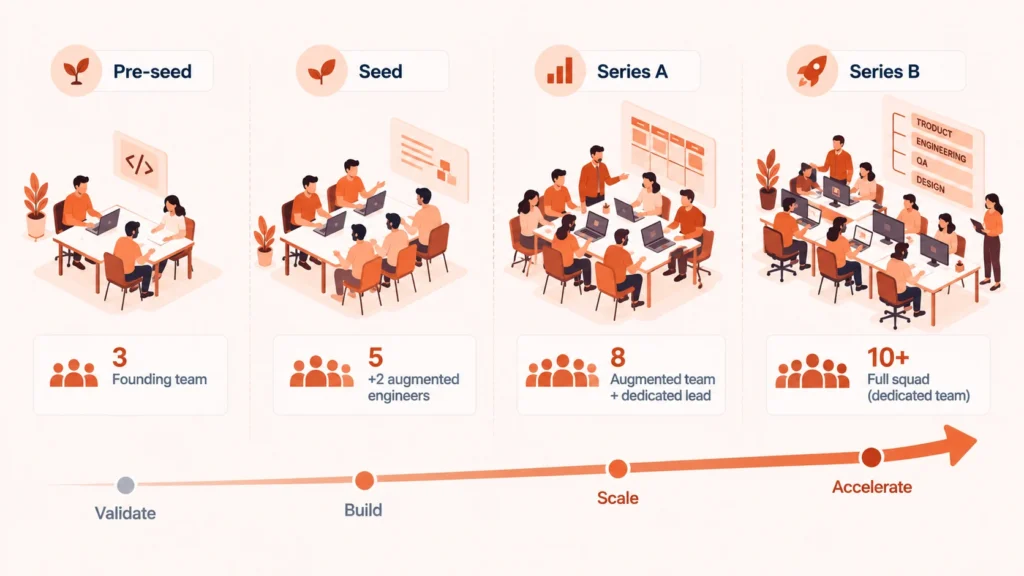
At InApps, the path from augmentation to dedicated team to Offshore Development Center runs within a single provider relationship. A startup that places two augmented engineers at Seed, scales to five at Series A, and converts to a dedicated team at Series B does so without a new vetting cycle, new contracts, or new onboarding — the same engineers, same account manager, same standards.
What Startups Get Wrong With Staff Augmentation
Kanerika’s 2026 analysis identifies the most common startup failure modes:
Treating augmented engineers as contractors receiving task lists. Startups that get the most from augmented teams include them in planning sessions, give them product context, and invite them to retrospectives. Those that hand them tickets in Jira and expect contractor-quality output get exactly that — regardless of individual engineer seniority.
Under-briefing the engagement. Augmented engineers cannot compensate for undefined requirements. A weak brief produces a well-executed version of the wrong thing. The investment in writing clear acceptance criteria before the sprint starts is the highest-ROI hour in any augmentation engagement.
Prioritising hourly rate over total cost. A “cheaper” provider with a 30–35% productivity hit in month one costs more by month three than a higher-rate provider with genuine vetting and a 10–12% ramp-up loss. Cloud Employee’s 2026 analysis found a mismatched hire who stays 60 days before replacement costs more than 50% of their annual salary in recruiting, onboarding, and rework overhead.
Skipping the IP and security conversation. Pre-Series B startups often do not have a procurement function. IP terms, NDA coverage, and security controls are signed without detailed review. For a company heading into a Series A or Series B raise, IP ambiguity in the codebase can create due diligence complications that delay the round.
Cost Reality for Startups: What the Numbers Look Like
For a Seed-stage company trying to extend runway while maintaining velocity, the cost comparison matters. Here is the real math for a senior full-stack engineer:
| Cost element | US onshore hire | Vietnam augmentation (InApps) |
|---|---|---|
| Annual base salary | $140,000–$180,000 | — |
| Employer overhead (benefits, payroll tax) | $42,000–$72,000 | — |
| Recruitment cost | $14,000–$27,000 one-time | None |
| Time to first commit | 3–4 months | 1–2 weeks |
| Year-one total | $196,000–$279,000 | ~$57,600–$96,000 |
| Exit if role no longer needed | Redundancy process | 2 weeks’ notice |
| IP ownership | Yours | Yours from first commit |
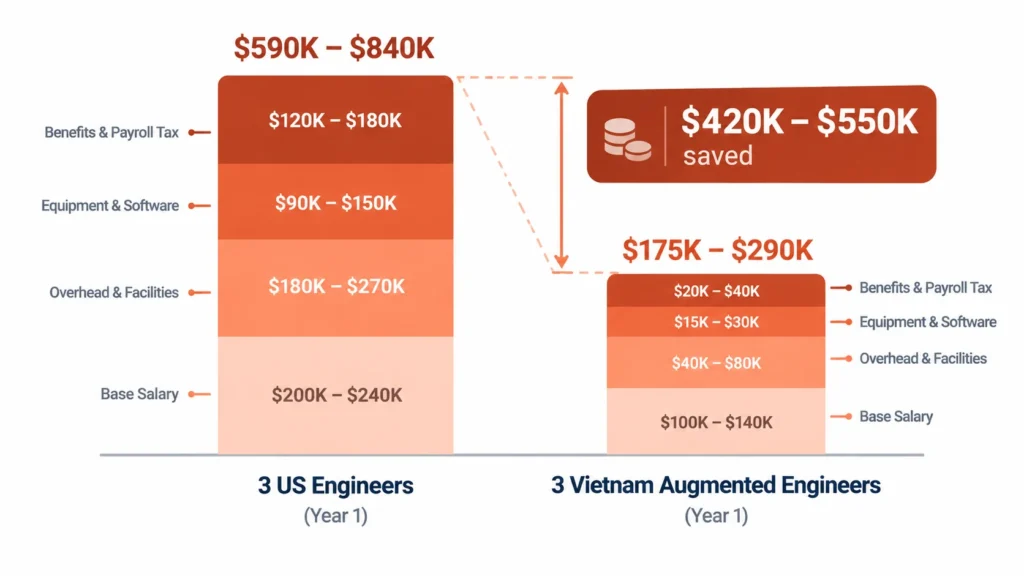
For a Series A startup with $8–12 million raised and a 24-month burn runway, the delta between hiring three US engineers ($590,000–$837,000/year) and augmenting three senior Vietnam-based engineers through InApps ($172,800–$288,000/year) is $420,000–$550,000 — enough to fund another product sprint, a go-to-market push, or extend runway by four to six months.
InApps and the Startup Journey
InApps has worked with startups across the full funding range — from Seed-stage companies building their first production systems to Series B companies running 10+ engineer squads from Vietnam.
The startup-specific commitments:
- Senior engineers only. Not a bench of mid-level engineers with two seniors on the pitch. Every engineer passes the same four-stage vetting process (3% pass rate).
- First engineer in 1–2 weeks. Matched to your specific stack before you see a profile.
- No minimum term. Two weeks’ notice to scale either direction. Startup roadmaps change; your engagement model should too.
- IP from the first commit. For founders going into a funding round, code ownership clarity matters. InApps assigns IP on creation — not on final payment.
- ISO 27001:2022 certified. Company-managed devices, VPN, NDA before codebase access. For startups handling regulated data (fintech, healthtech), this matters at due diligence.
InApps has delivered for clients across SaaS, fintech, healthcare, and eCommerce — including Techcombank, Prudential, and multiple Series A SaaS companies in the US and Australia.
“Quality engineers, proposed within days. But what actually made the difference was the culture fit — they worked like they were part of our team from day one.” — Engineering Leader, Future Processing (InApps client)
Seed or Series A and need to add engineers in the next sprint? Book a 30-minute discovery call → — no pitch, no invoice, matched profiles within five days.
Red Flags to Avoid When Choosing a Provider as a Startup
| Red Flag | Why It Matters for Startups |
|---|---|
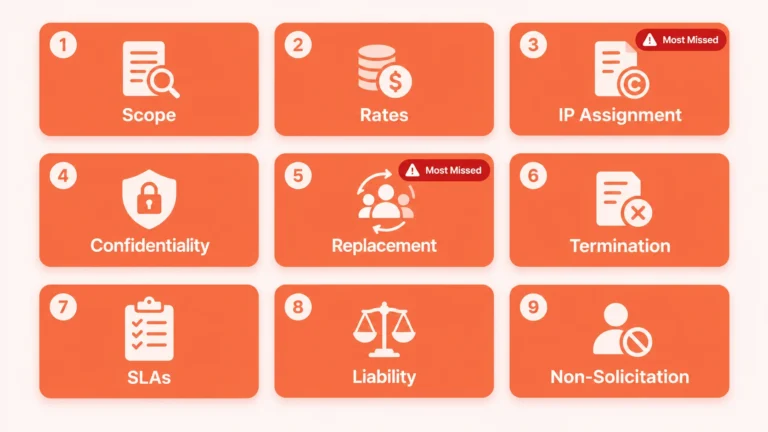
| No 30-day replacement guarantee | You cannot absorb a 6-week vacancy at Seed |
| 6-month minimum term | Your roadmap will change before the contract ends |
| Cannot name a specific onboarding plan | Founders will manage onboarding themselves — expensive |
| No clear IP assignment clause | Creates due diligence risk in your next round |
| Pass rate above 30% | CV screening, not genuine technical vetting |
| No named account manager after placement | You will manage the engagement yourself |
| Shared engineers across multiple clients | Attention split; not actually augmentation |
Frequently Asked Questions
Is staff augmentation right for startups?
At Seed stage and above, yes — provided you have a technical lead who can direct the incoming engineers. At Pre-seed without a dedicated tech lead, managed outsourcing or a fixed-price MVP engagement produces better results. The prerequisite is not funding — it is internal management capacity to direct the engineers and maintain architectural coherence.
How much does staff augmentation cost for a startup?
A senior Vietnam-based engineer through InApps runs within the 2026 market range of $30–$50/hour, or approximately $4,800–$8,000/month all-in. Compared to a US onshore hire ($196,000–$279,000 year-one total cost including overhead and recruitment), augmentation delivers 40–60% savings with no recruitment fee, no minimum-term commitment, and two weeks’ notice to scale down. For three engineers, the annual delta is $420,000–$550,000.
When should a startup use staff augmentation vs hiring in-house?
Augmentation fits roles that are needed for 3–18 months, specialist skills where the global pool is the only viable source (AI/ML, security, DevOps), and situations where the 3–4 month hiring cycle would miss a launch date or milestone. Hire in-house for roles that are central to the product roadmap long-term, require deep institutional knowledge, and justify the fixed overhead of permanent employment at your funding stage.
Can a startup use staff augmentation after Series A?
Yes — Series A is typically the optimal stage for augmentation. The conditions are in place: a CTO or VP Engineering to direct the work, a funded 12–18 month roadmap, and specific skill gaps or parallel workstream needs that augmentation addresses faster than hiring. Post-Series A companies commonly run augmentation for speed-to-deploy (getting funded headcount into the sprint while hiring runs in parallel) and for specialist roles in global shortage.
What is the difference between staff augmentation and an MVP development agency for startups?
Staff augmentation adds named engineers to your existing team — you manage the work, own the process, and direct the engineers. An MVP agency owns a defined delivery scope — you provide product requirements and review milestones, they manage the build. Augmentation requires internal technical leadership; an MVP agency does not. For pre-seed companies without a dedicated tech lead, an MVP engagement produces better outcomes. For seed-stage companies with a CTO, augmentation gives more control and IP ownership from day one.
What risks does augmentation carry for startups specifically?
Three risks are most acute at startup stage: (1) management overhead — augmented engineers require active direction; without a dedicated tech lead, they consume the founding engineer’s time; (2) IP terms — startups heading into a fundraise need explicit IP assignment from the first commit, not gated behind final payment; (3) exit terms — a 6-month minimum term against a startup roadmap that changes quarterly creates financial exposure. Verify all three before signing.
Key Takeaways
- Pre-seed without a tech lead → managed outsourcing or MVP agency. Seed with a tech lead → augmentation viable for 1–2 specialists.
- Series A is the optimal stage: funded roadmap, CTO in place, specific gaps, parallel workstreams. Three augmented engineers save $420K–$550K vs onshore equivalent.
- Series B: augmentation for spikes + dedicated team for standing squads.
- Common startup mistakes: treating engineers as task-receivers, under-briefing, prioritising rate over TCO, skipping IP review.
- Early-stage hiring rate fell to 27% in 2026 (down from 49%) — lean teams make augmentation’s variable spend model more relevant.
- AI-skill jobs grew 69% YoY (PwC 2026) — the global talent pool for these roles is only reachable via augmentation.
- Non-negotiable for startups: 30-day replacement guarantee, no 6-month minimum, IP from first commit, named account manager post-placement.
Work with us
Need a team that can do this on your codebase?
Tell us what you are shipping and we will send back a scope, a team shape and a fee. No obligation.
Book a free call