
On this page
TL;DR: Use staff augmentation when you have a technical lead who can direct the work, a clear backlog, and a specific gap — in capacity, in skills, or in time. Do not use it when no internal tech lead exists, when the scope is undefined, or when the engagement is shorter than six weeks. The decision is not about cost or geography. It is about whether the conditions for augmentation to succeed are in place before you sign.
The Question Behind the Question
Most searches for “when to use staff augmentation” are really asking one of two things:
- Is this the right model for my situation? — The answer depends on whether specific conditions are in place at your organisation, not on the model’s theoretical benefits.
- Am I about to make the wrong call? — Augmentation is bought for the wrong reason more often than it is used correctly. The counter-signals below matter as much as the triggers.
Both questions have the same answer: start with internal conditions, not external provider options. The trigger for augmentation is always inside your team, not in a vendor’s rate card.
Trigger 1: Your Hiring Pipeline Cannot Meet the Roadmap Timeline
The signal: A critical role has been open for 30+ days. Candidates are either unavailable, too expensive onshore, or too slow to pass through the hiring funnel. The roadmap is accumulating tickets faster than your team can close them.
Why augmentation fits: The SHRM 2025 Recruiting Benchmarking Report found the median time-to-fill for non-executive roles was 44 days — before notice period or ramp-up. For specialist roles (AI/ML engineers, security architects, senior DevOps), it runs 70+ days. Staff augmentation with a pre-vetted bench delivers a matched shortlist in five business days and a first pull request inside two weeks. The model exists precisely for this mismatch between hiring speed and business need.
The condition that must exist: A technical lead with capacity to brief, interview, and direct the incoming engineer. Augmentation compresses hiring time; it does not eliminate the management requirement.
Trigger 2: You Need a Skill Your Team Does Not Have — For a Defined Period
The signal: The roadmap requires a capability that does not exist on your current team: a LangChain specialist to build an AI feature, a cloud architect for a Kubernetes migration, a QA automation engineer to stand up a Playwright suite. The skill is needed for 3–12 months; hiring full-time for a role that may not be needed at the same intensity after the initiative cannot be justified.
Why augmentation fits: Building a permanent team for every technical capability a product requires is economically wasteful. Staff augmentation makes it practical to bring in an AI/ML engineer for a model buildout, a DevOps architect for an infrastructure migration, or a senior mobile engineer for a platform expansion — then release that capacity when the initiative is complete.
The data: Jobs requiring AI skills grew 69% year-over-year in 2026, nearly eight times the overall jobs market (PwC 2026 AI Jobs Barometer). Employers posted 1,229,505 jobs requiring AI skills between January 2025 and January 2026 (CompTIA 2026). The global talent pool for these roles is not accessible through local hiring at any useful speed. Augmentation reaches it in weeks.
The condition that must exist: The skill gap is specific and bounded — you can write a role brief. Augmentation for a vaguely defined “AI person” with no clear deliverables does not work.
Trigger 3: A Deadline Cannot Move But Your Team Cannot Absorb It
The signal: A product launch, compliance deadline, regulatory cutover, or investor demo has a fixed date. Your current team can ship their existing commitments on time, but cannot absorb the additional work without dropping something or burning out.
Why augmentation fits: Augmentation is specifically designed for this: temporary capacity that joins an active sprint without requiring a new process, a new codebase context from scratch, or a project management layer. GitLab used staff augmentation to scale development by 40% during heavy release cycles without sacrificing code quality (Softura, 2026). The fixed timeline is absorbed by augmenting throughput, not by compressing the work.
The condition that must exist: The additional work is well-defined enough to be ticketed. Engineers who join a sprint with a clear backlog contribute within the first two weeks. Engineers who join an ambiguous situation with undefined requirements produce misaligned work at full price.
Trigger 4: You Are Deploying Capital Faster Than Permanent Hiring Allows
The signal: A funding round has closed. You have budget to hire engineers, but the 3–4 month hiring cycle means the capital will sit uninvested while the roadmap waits. Competitors are shipping.
Why augmentation fits: Post-funding, augmentation deploys headcount into the sprint in one to two weeks per engineer — in parallel with the permanent hiring pipeline. The augmented engineers run the roadmap while recruiting fills the long-term roles. By the time a permanent hire is through the pipeline and ramped, the augmented engineers have delivered six to eight weeks of output that the permanent hiring timeline would have lost.
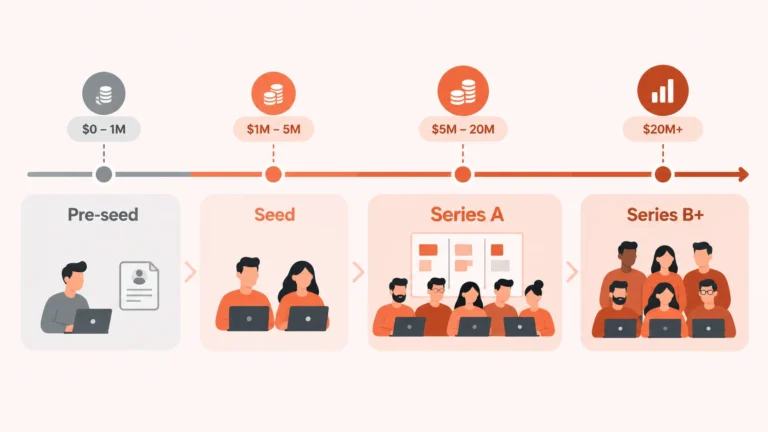
The condition that must exist: The CTO or VP Engineering is in place and can direct the incoming engineers. This trigger most commonly arises at Series A and Series B — the optimal stages for augmentation, as covered in the Staff Augmentation for Startups guide.
Trigger 5: A Legacy System or Migration Requires Specialist Expertise You Cannot Sustain
The signal: A legacy system is approaching end-of-life, a cloud migration has a data-centre exit deadline, or a compliance programme requires security expertise outside your normal stack. These initiatives are critical but time-bounded. Building a permanent team for work that will not exist at the same intensity in 18 months is not the right call.
Why augmentation fits: Technical debt costs US companies an estimated $1.52 trillion annually (Softura, 2026). Modernisation is high-stakes; outsourcing it removes architectural control and introduces vendor dependency. Augmentation keeps your engineering lead in control of architecture decisions while augmented specialists — cloud architects, DevOps engineers, legacy migration experts — execute the technical work. The initiative completes; the augmented engineers leave; your team retains the codebase and the documentation.
The condition that must exist: The migration scope and architecture approach are defined before engineers are placed. Augmented engineers execute; they do not define strategy for an unfamiliar system.
Trigger 6: You Want to De-Risk a Full-Time Hire in a Scarce Role
The signal: You need a senior engineer in a specialism where local hiring is slow and expensive, and a bad hire would set the team back six months. You would rather trial the engineer in a real engagement before extending a permanent offer.
Why augmentation fits: Augmentation functions as a trial employment period without the irreversibility of a permanent hire. The engineer joins the sprint, works on your actual codebase, is visible in code review, and demonstrates genuine seniority — or does not. A 30-day replacement guarantee eliminates the downside if the first placement is wrong. A conversion-to-hire clause enables a permanent offer if it is right.
The condition that must exist: The provider supports conversion-to-hire and does not charge a punitive buyout fee. Verify this in the contract before signing.
Trigger 7: A Parallel Workstream Requires Capacity Your Core Team Cannot Spare
The signal: The roadmap requires feature development, infrastructure work, and a migration or integration running simultaneously. Your core team of eight engineers can own two of three. The third sits in the backlog accumulating delay.
Why augmentation fits: Augmented engineers run the third workstream under your engineering lead’s direction, with your architecture standards and your tools. They are not a separate delivery unit — they are additional capacity on your org chart. When the parallel initiative completes, the engagement scales back down on two weeks’ notice. Your core team never absorbed the coordination overhead of a full third workstream, and your roadmap delivered all three.
The condition that must exist: A clear owner from your internal team for each workstream. Parallel work without designated internal owners creates coordination debt faster than it delivers throughput.
5 Counter-Signals: When Staff Augmentation Will Not Work
Knowing when not to use augmentation is as important as the triggers above.
Counter-signal 1: No internal technical lead with capacity to direct the work.
This is the single most predictive failure condition. Without a CTO, VP Engineering, or principal engineer who can write tickets, run code review, and unblock engineers, augmentation amplifies whatever management capacity you provide — which means zero output at full price. If your senior engineers are already fully allocated, augment them, not around them.
Counter-signal 2: The scope is undefined.
Augmented engineers execute against a clear backlog. An engagement that starts with “we need some engineers to help figure out what to build” will produce rework, misalignment, and a management burden that exceeds the capacity gain. Define the scope, write the tickets, and set acceptance criteria before placing the first engineer.
Counter-signal 3: The engagement is shorter than six weeks.
A two-to-four week ramp-up on an unfamiliar codebase is unavoidable. On a six-week engagement, this is a third of the contract. On a three-month engagement, it is 25%. On a twelve-month engagement, it is under 10%. The minimum viable engagement for augmentation to deliver positive ROI — counting ramp-up loss — is typically six weeks, preferably longer.
Counter-signal 4: You need a fixed-price deliverable with outcome accountability.
Staff augmentation vendors guarantee the engineer’s qualifications, not the project’s outcome. If you need a fixed budget, defined acceptance criteria, and a vendor accountable for delivery — you need project outsourcing or fixed-price software product development. Augmentation is time-and-materials; the accountability for the outcome stays with you.
Counter-signal 5: The codebase is undocumented and no senior engineer can support onboarding.
On a poorly documented legacy codebase with no one available to walk an incoming engineer through the architecture, ramp-up extends from 2 weeks to 4–6 weeks. Radixweb’s 2026 analysis found real total engagement cost runs 20–40% above the quoted rate in this scenario. Prepare the onboarding materials before placing the first engineer, not after.
The Decision Checklist: 5 Questions in Order
Answer these in sequence. The first “no” determines the right model.
| # | Question | If yes | If no |
|---|---|---|---|
| 1 | Is there an internal tech lead with capacity to direct the work? | Continue to Q2 | → Use outsourcing or managed services |
| 2 | Is the scope defined enough to write a backlog? | Continue to Q3 | → Define scope first; delay placement |
| 3 | Will the engagement run at least 6 weeks? | Continue to Q4 | → Fixed-price project or outsourcing |
| 4 | Is the need time-bounded or variable? (Not a permanent core role) | Continue to Q5 | → Consider permanent hire or dedicated team |
| 5 | Is the work core product IP you need to own directly? | → Staff augmentation | → Could be outsourcing if non-core |
All five questions answered correctly → staff augmentation is the right model for your situation.
When You Are on the Fence: Start With One Engineer
If the decision is unclear, the lowest-risk path is to start with one augmented engineer on a defined piece of work — a specific feature, a bounded integration, a sprint of test automation. Run the engagement for four to six weeks. Evaluate: did the engineer’s output meet expectations? Did the management overhead feel sustainable? Did the onboarding friction resolve quickly?
The answers tell you whether augmentation will work at scale for your team — at the cost of one engineer’s monthly rate, not a six-month commitment across five engineers.
At InApps, all engagements start this way if the client wants to: one engineer, two weeks’ notice to scale or exit, no minimum-term commitment. The first sprint is the proof.
How InApps Supports the Decision
InApps will tell you on the first call if augmentation is not the right model — including when we would point you to fixed-price Software Product Development, a Dedicated Team, or an Offshore Development Centre instead.
When augmentation is right: Named senior engineers in your sprint in 1–2 weeks. 3% pass rate vetting. 92% retention at 12 months. 30-day replacement guarantee. Two weeks’ notice to scale. IP from the first commit. ISO 27001:2022 controls.
When it is not: We will describe which model fits, what it costs, and what the transition would look like — before you sign anything.
“On time. Every time. And when I had questions — any questions — they were answered in full. That’s not common.”
— Margo Flanagan, Director, Two Raw Sisters (InApps client)
Ready to run the decision? Book a 30-minute discovery call → — no pitch, no invoice, a direct answer on whether augmentation fits your situation.
Frequently Asked Questions
When should you use IT staff augmentation?
Use it when: a hiring pipeline cannot meet a roadmap deadline; a specific skill is needed for a bounded period; a fixed deadline cannot be absorbed by the current team; capital needs to be deployed faster than permanent hiring allows; a legacy migration or modernisation needs specialist execution; a parallel workstream exceeds current team capacity. All require one non-negotiable condition: an internal technical lead with capacity to direct the augmented engineers.
When should you NOT use staff augmentation?
Five counter-signals: no internal tech lead with capacity to direct the work; scope is undefined; the engagement will run fewer than six weeks; you need a fixed-price deliverable with vendor accountability; the codebase is undocumented with no senior available to support onboarding. In each case, another model — outsourcing, fixed-price development, or a dedicated team — is a better fit.
How do you know if augmentation is the right model?
Answer five questions in sequence: (1) Is there an internal tech lead with capacity? (2) Is the scope defined enough to write a backlog? (3) Will it run at least six weeks? (4) Is the need time-bounded or variable? (5) Is the work core product IP? All five yes → augmentation fits. The first no → a different model fits better.
How long does a typical staff augmentation engagement run?
Most engagements run 3–18 months. Shorter than six weeks rarely produces positive ROI when ramp-up cost is counted. Longer than 18 months with the same engineers typically warrants a transition to a dedicated team or permanent hiring for the most central roles — the economics and the knowledge continuity argument both shift past that point.
Can you use staff augmentation for a new product build?
For the ongoing development phase — yes. For the initial build where scope can be defined upfront and vendor accountability for delivery is valuable — a fixed-price engagement or outsourcing is typically the better fit. The practical pattern: outsource the initial build to a defined scope, then augment engineers in for ongoing product development once it is live. This is the hybrid model that Gartner’s 2024 research found produces 30% higher delivery rates than either model alone.
What is the minimum team size for staff augmentation?
One engineer. Augmentation starts at a single specialist and scales as the roadmap demands. The minimum for it to make economic sense is not a headcount threshold — it is the six-week minimum engagement duration. One engineer for twelve months delivers far better ROI than three engineers for three weeks.
Key Takeaways
- 7 triggers: hiring gap, specific skill need, fixed deadline, deploying capital post-funding, migration/modernisation expertise, de-risking a hire, parallel workstream.
- 5 counter-signals: no tech lead, undefined scope, under six weeks, fixed-price deliverable needed, undocumented codebase.
- The gate question: does an internal technical lead with capacity to direct the work exist? No → do not augment.
- Start with one engineer if uncertain — four to six weeks, two weeks’ notice, answers the question at one month’s cost.
- The 5-question checklist determines fit before the first vendor call.
- SHRM 2025: median time-to-fill is 44 days. Augmentation with a pre-vetted bench is 5 business days to shortlist, 2 weeks to first commit.
Work with us
Need a team that can do this on your codebase?
Tell us what you are shipping and we will send back a scope, a team shape and a fee. No obligation.
Book a free call